
Spend some time around accountants who’ve clearly gotten ahead of their peers, and you start noticing something. It’s rarely about who’s naturally sharper with numbers. Usually it comes down to standards knowledge that goes beyond what their home country strictly requires — and in most cases, they went out and built that knowledge on purpose.
That’s part of the reason a financial reporting course online has become such a common search these days, instead of just waiting around for an employer to eventually get around to training. Makes sense, honestly. Nobody wants to be cramming IFRS 15 for the first time with a client’s audit deadline sitting two days out.
So here’s what this piece actually covers: what a decent financial reporting course online should teach you, who genuinely needs one, and how you tell a solid program apart from something that’s basically a repackaged PDF with a fancy landing page.
What Does a Financial Reporting Course Online Actually Cover?
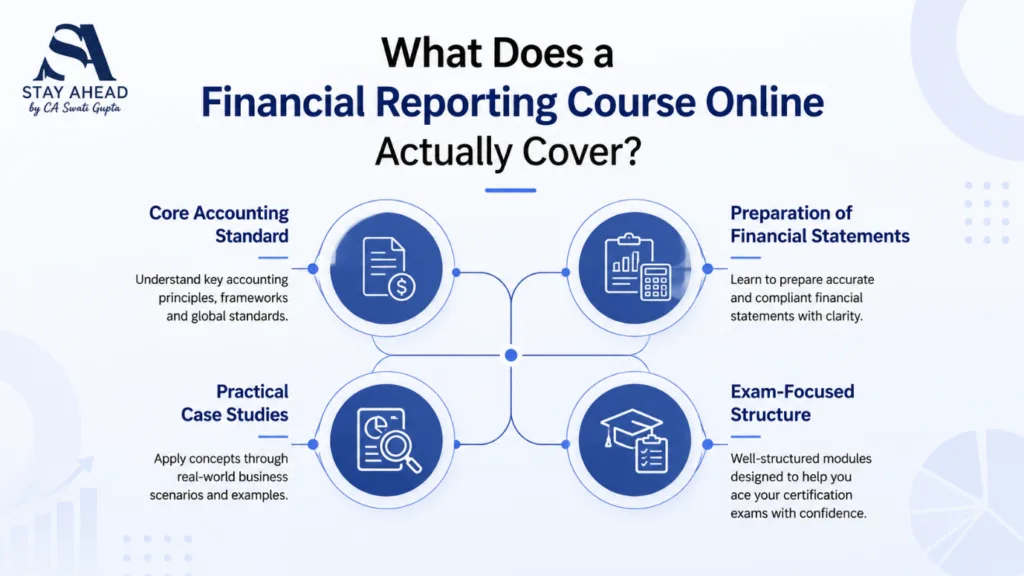
There’s a common assumption that financial reporting is just “advanced accounting” with extra steps. It’s not quite that. Think of it as the language a business uses to tell investors, regulators, and lenders whether things are actually going fine — and that language shifts the moment you cross a border. A course that’s worth paying for tends to cover four areas properly.
Core Accounting Standards
International Financial Reporting Standards (IFRS), and Ind AS too if you’re working with Indian companies. Expect to spend real hours with IAS 16 (Property, Plant & Equipment), IFRS 15 (Revenue Recognition), IFRS 16 (Leases), and IFRS 9 (Financial Instruments) — these four keep coming up in actual audit work more than almost anything else on the syllabus.
Preparation of Financial Statements
Not just reading what a rule says, but actually building a balance sheet, an income statement, a cash flow statement — disclosures and all — to a standard that would hold up under an examiner’s or auditor’s scrutiny.
Practical Case Studies
Case studies end up mattering more than most people expect going in. Reading about revenue recognition in the abstract is one thing. Working through how a company should actually book revenue on a three-year contract with milestone payments is a completely different exercise, and that’s usually the point where the concept finally clicks for good.
Exam-Focused Structure
If ACCA’s Diploma in IFRS (DipIFR) is the target, the course needs to be built around the exam itself, not just the topic. Past papers, mock tests, timed practice under real conditions. Knowing the theory won’t carry you through three hours of exam pressure on its own.
Who Should Take a Financial Reporting Course Online?
This hasn’t been a niche skill reserved for auditors in a long time. CA, and ACCA students get an obvious benefit, since it firms up the conceptual base ahead of professional exams. But working accountants and finance executives whose companies are mid-transition to IFRS or Ind AS need it just as much — and that’s a much bigger crowd than people assume, given how many Indian companies have made that shift over the last decade or so.
Anyone with an eye on international roles has a case too. IFRS is used or permitted in well over 140 countries, so having a real grip on it opens doors that domestic GAAP knowledge alone just doesn’t. Freelance accountants and consultants who want to offer IFRS advisory work belong here as well, along with fresh graduates hunting for something on a resume that actually sets them apart from the next fifty applicants in the pile.
If any of that sounds like your situation, stitching together free YouTube clips and five-year-old PDFs isn’t going to get you there anywhere near as fast as a properly structured course would.
Why Online Learning Makes Sense for This Subject?
Not too long ago, this kind of training happened mostly in classrooms or firm-sponsored workshops you had to physically show up for. That’s changed, and for the better, honestly. Learning at your own pace matters far more than people give it credit for when you’re also holding down a full-time job, or grinding through exam prep on the side after hours.
There’s the rewind factor too. When something like deferred tax or consolidation doesn’t land the first time through — and it usually doesn’t — being able to jump straight back to that exact recorded segment beats sitting in a classroom hoping the instructor happens to repeat it. Online formats also put you in front of faculty you’d otherwise never reach, regardless of which city they happen to teach out of.
Language plays a bigger role here than most providers let on. Courses offered in both Hindi and English make a genuine difference for learners who find technical standards easier to absorb in their first language, rather than mentally translating every clause as they go. For a subject this dense, being able to pause, rewind, and sit with a lecture until it actually sinks in is often the difference between clearing the exam and not.
What to Look for Before Enrolling
Not everything labeled “financial reporting” online is worth handing your money to, and it’s easy to get burned by the wrong one. A few things are worth checking before you swipe your card.
Who’s Actually Teaching It
You want instructors who are practicing Chartered Accountants — people who’ve handled real IFRS transitions, not someone reading off slides they didn’t write. There’s a real gap between a teacher who explains what a standard says and one who can explain why it exists in the first place and where companies typically trip over it in practice.
How Current the Curriculum Is
Standards get amended fairly often, and a course built back in 2019 that hasn’t been touched since almost certainly doesn’t reflect current IFRS 15 or IFRS 16 guidance. If a provider can’t tell you when the material was last revised, treat that as a red flag on its own.
Doubt-Clearing Support
Topics like financial instruments or business combinations are genuinely confusing the first time around, and a course offering live sessions or a real way to ask questions is worth a lot more than one that just dumps pre-recorded videos on you and vanishes.
Structured Study Plan and Practical Assignments
If ACCA DipIFR specifically is the goal, look for a structured, week-by-week study plan rather than a loose pile of lectures — it keeps you honest about where you actually stand instead of letting things pile up right before exam day. And push for courses built around practical assignments, not just reading material. Preparing an actual consolidated financial statement with intercompany eliminations teaches you more than any amount of reading about how consolidation is supposed to work.
The Career Impact of Learning Financial Reporting the Right Way
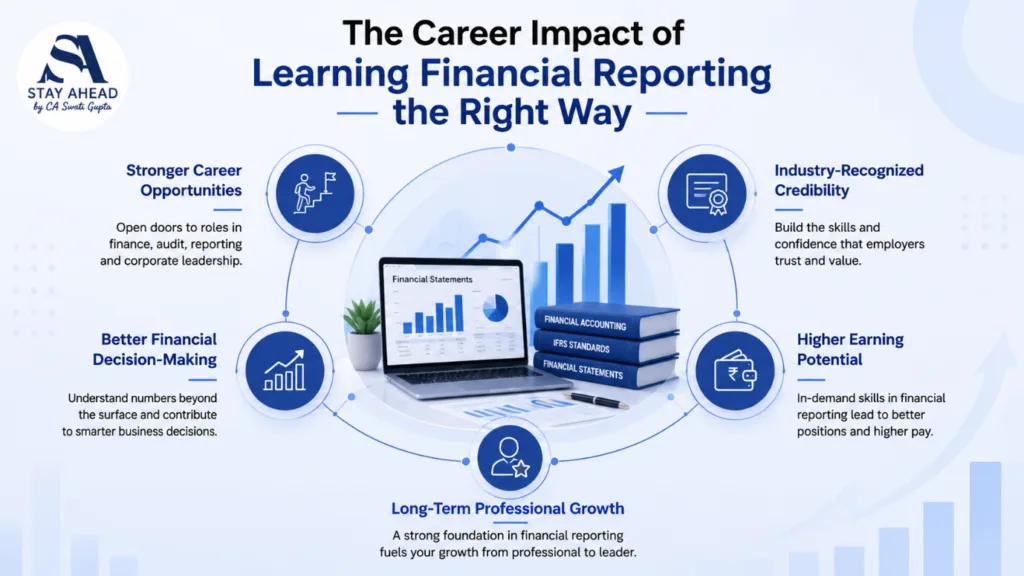
Here’s the honest return-on-investment question people are really asking when they think about paying for a course like this. Companies transitioning to Ind AS or IFRS constantly struggle to find staff who genuinely understand the standards, rather than just following a checklist someone else wrote years ago — and that gap is exactly where a well-trained professional starts to matter.
In practical terms, this usually shows up as better positioning for roles at MNCs, Big 4 firms, or any company carrying international reporting obligations. It also shows up in smaller ways that add up: more confidence walking into an audit involving IFRS-compliant clients, a real edge in CA, or ACCA exams where financial reporting carries heavy weightage, and — maybe the most valuable part — being able to actually advise a client or employer through a standards transition instead of just reacting to it after the fact.
Why Choose CA Swati Gupta?
If you’re still weighing where to actually take this course, here’s the case for CA Swati Gupta’s programs.
She teaches from real, hands-on IFRS and Ind AS experience rather than reciting a textbook, and that tends to come through fairly quickly once you sit through a lecture. Her courses are built around ACCA’s Diploma in IFRS along with core financial reporting standards, and the topics that usually intimidate students — IAS 16, IFRS 15, IFRS 9 — get broken down in a way that’s genuinely easy to follow instead of dense and overly formal.
The bigger differentiator is accessibility. Courses run in both Hindi and English, which matters a lot for learners who pick up technical standards faster in their first language instead of mentally translating every clause along the way. Sessions follow the actual exam pattern, with a study plan and direct guidance aimed at clearing DipIFR on the first attempt, so you’re not left guessing at exam strategy on your own.
She’s also fairly visible outside the paid course itself, regularly posting breakdowns of accounting standards and reporting scenarios across YouTube and LinkedIn. That gives you a decent preview of her teaching style before committing to anything. If depth, clarity, and exam-focused preparation are what you’re after in a financial reporting course online, this is close to what that actually looks like in practice.
Conclusion
Financial reporting isn’t something you can afford to learn superficially, especially if you’re aiming for a career involving audits, cross-border reporting, or professional certifications like ACCA. A well-designed financial reporting course online gives you the structure, practical exposure, and exam readiness that self-study on its own simply can’t match.
Whether you’re a student prepping for DipIFR, a working professional adapting to Ind AS at your company, or someone looking to future-proof an accounting career, investing in the right course now saves a lot of confusion later. Take the time to check faculty experience, curriculum updates, and support systems before committing — it makes a real difference in how much you actually retain and apply.
That’s the exact gap caswatigupta is built to close — practical, exam-focused financial reporting training led by someone who’s actually worked through real IFRS and Ind AS transitions, not just taught around them.
FAQs
1. Is a financial reporting course online worth it for someone already working as an ccountant?
Yes. Many companies are shifting to Ind AS or IFRS-based reporting, and understanding these standards properly makes you significantly more valuable in your current role, even without a certification attached.
2. How long does it typically take to complete a financial reporting course online?
It depends on how deep the course goes, but most structured programs — especially ones aligned with ACCA DipIFR — can be finished in a few months with consistent study of a few hours a week.
3. Do I need a CA background before enrolling in an IFRS-focused course?
Not necessarily. A finance or accounting background helps, but many courses are built to develop concepts from the ground up, which makes them workable for graduates and early-career professionals too.
4. What’s the difference between learning IFRS and learning Ind AS?
IFRS is the global framework used across many countries, while Ind AS is India’s version of it, adapted with certain local modifications. Most financial reporting courses cover both together, since they overlap heavily.
5. Can I take a financial reporting course online while working full-time?
Yes, and that’s actually one of the biggest reasons professionals lean toward online formats — recorded sessions and flexible scheduling let you study around work commitments without needing to take time off.