
If your company reports to investors, lenders or a foreign parent, someone will eventually ask for your numbers in a different accounting language. That is where GAAP conversion advisory steps in. Your books stay the same. What changes is how transactions are recognised, measured and presented so they meet another framework’s rules.
Most finance teams run into this during a funding round, a cross-border acquisition or an overseas listing. The Ind AS or IFRS statements that worked at home suddenly don’t fit. Deadlines slip, spreadsheets multiply and restatements get expensive. Planning ahead with GAAP conversion advisory removes most of that pressure.
Finance and deal-making are closely linked. Anyone who has worked in Investment Banking knows a valuation model loses credibility the moment a target’s financials can’t be compared with its peers. Consistent reporting is what lets a deal move from term sheet to closing without last-minute surprises.
How GAAP Conversion Advisory Helps Businesses Achieve Accurate Financial Reporting
At its heart, GAAP conversion advisory is about trust. When a lender in New York or an investor in London reads your statements, they want to know the numbers follow rules they understand. An advisor bridges that gap. They identify every policy difference, quantify its effect and document why each adjustment was made.
It also builds skills inside your team. Many firms bring in finance trainees through Accounting Internships. A live conversion project is one of the best ways for them to see how standards work in real transactions rather than in textbooks.
Fewer Surprises at Audit Time
When adjustments are mapped and documented early, auditors spend less time questioning your treatment and more time testing it. That usually shortens the audit cycle and reduces last-minute queries.
Numbers Investors Can Compare
Converted statements let stakeholders compare your margins, leverage and earnings with peers reporting under the same framework. That comparability often affects valuation more than people expect.
IFRS and GAAP: Where the Two Frameworks Actually Differ
The debate around IFRS and GAAP comes down to philosophy. IFRS is principles-based and leaves room for professional judgment. US GAAP is more rules-based, with detailed guidance for specific industries and situations. Neither is “better”. They simply produce different numbers in certain areas.
Differences That Move the Numbers
- Inventory: US GAAP allows LIFO. IFRS does not.
- Development costs: IFRS requires capitalisation once specific criteria are met. US GAAP generally expenses them.
- Impairment reversals: IFRS permits reversal for most assets other than goodwill. US GAAP does not.
- Leases: IFRS 16 brings nearly all leases onto the balance sheet under one model. US GAAP keeps a split between finance and operating leases in the income statement.
Why These Differences Matter in Practice
A company with large inventories or heavy R&D spending can see profit shift noticeably after conversion. A solid GAAP conversion advisory engagement quantifies those shifts before your stakeholders find them on their own.
What an IFRS Conversion Involves
An IFRS conversion usually begins with a gap analysis. The team compares your current accounting policies with the target standards and lists every area that needs adjustment, such as revenue recognition, financial instruments, leases and provisions.
Groups face an extra layer of complexity. Preparing Consolidated Financial Statements means deciding which entities fall inside the group. IFRS 10 uses a single control model. US GAAP applies voting-interest and variable-interest tests. The same structure can therefore produce a different consolidation perimeter, and that affects reported assets, liabilities and non-controlling interests.
When to Consider GAAP Conversion Services
You don’t need to wait for a crisis. Businesses typically look for GAAP conversion services when they:
- Have a foreign parent company that reports under US GAAP
- Plan a cross-border merger, acquisition or joint venture
- Prepare for an overseas listing or private placement
- Borrow from international lenders with specific reporting covenants
- Need group-level reporting across subsidiaries in different countries
Starting GAAP conversion advisory six months before a deadline costs far less than starting six weeks before it. Rushed projects rely on shortcuts, and shortcuts cause restatements.
How a Conversion Project Runs, Step by Step
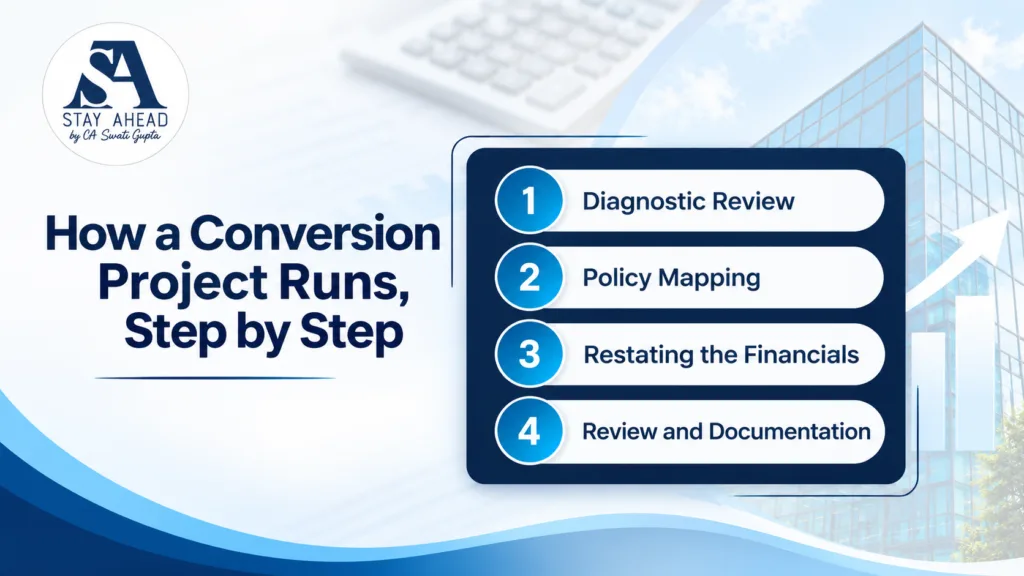
Step 1: Diagnostic Review
The advisor studies your chart of accounts, accounting policies and recent statements. The goal is a clear list of where your current framework and the target framework disagree.
Step 2: Policy Mapping
Each difference gets a documented treatment. Good GAAP conversion advisory never leaves a judgment call undocumented, because someone will question it later.
Step 3: Restating the Financials
Opening balances, comparatives and current-period figures are restated. Deferred tax effects are recalculated, since almost every adjustment has a tax consequence.
Step 4: Review and Documentation
An independent review catches errors before auditors do. Reviewers with an audit mindset help here, and professionals holding a Certified Quality Auditor Certification bring process discipline that suits this stage well. You finish with a reconciliation file you can reuse next year.
Common Mistakes to Avoid
- Treating conversion as a one-time job. Reporting continues every quarter, so build a repeatable process.
- Ignoring tax. Adjustments change deferred tax balances.
- Thin documentation. Auditors want the reasoning, not just the numbers.
- Hiring help too late. The strongest GAAP conversion advisory happens before the deadline panic.
Why Choose caswatigupta?
A Practical, Standards-Led Approach
At caswatigupta, our GAAP conversion advisory starts with your actual transactions, not a generic template. We map each difference to the relevant standard so your statements hold up under scrutiny.
Clear Communication
Accounting jargon helps nobody. We explain adjustments in plain language so your management team and board understand what changed and why.
Support From Start to Finish
From the first gap analysis to the final reconciliation, you work with the same team. That continuity keeps the project consistent and fast.
Conclusion
Whether you are preparing for an acquisition, a listing or a foreign parent’s reporting calendar, GAAP conversion advisory gives you accurate, comparable and defensible financial statements. It saves time at audit, protects your credibility with investors and prevents costly restatements.
If you would rather not manage a conversion alone, talk to the team at caswatigupta. Our GAAP conversion advisory will help you move between frameworks with confidence.
Frequently Asked Questions
1. What is GAAP conversion advisory?
GAAP conversion advisory is professional guidance that helps a business restate its financial statements from one accounting framework to another, for example from Ind AS or IFRS to US GAAP. It covers gap analysis, policy mapping, restatement and documentation.
2. How long does a conversion take?
It depends on size and complexity. A small company may finish in a few weeks. A multi-entity group with complex instruments can take several months.
3. Is IFRS conversion the same as US GAAP conversion?
No. The direction and the standards involved differ, so the adjustments differ too. The overall method of diagnosing, mapping, restating and documenting is similar.
4. Who needs GAAP conversion services?
Subsidiaries of foreign groups, companies planning overseas listings or acquisitions, and businesses with international lenders or investors often need them.
5. Can a small business benefit from GAAP conversion advisory?
Yes. Small companies seeking foreign investment or bank funding often need converted statements. Early advice keeps the cost manageable.