
Spend enough time around finance professionals and IFRS eventually comes up. Usually with a sigh. Sometimes a laugh. International Financial Reporting Standards have quietly turned into the backbone of global financial reporting, and if you’re an accountant, auditor, or finance student, knowing them properly has stopped being optional. It’s expected now, plain and simple.
That’s the reason so many working professionals go hunting for a decent IFRS online course instead of waiting around for their employer to organise a classroom batch that may never actually happen. Online learning is flexible, demand for IFRS-trained people across MNCs, Big 4 firms, and consulting houses keeps climbing, and put those two things together and you get one of the most-searched accounting certifications of the last couple of years.
Here’s the catch, though. Not every IFRS online course is built the same way. Pick the wrong one and you can lose months chasing a certificate that taught you almost nothing useful. So before you swipe your card on whatever shows up first in a Google ad, let’s actually go through what matters.
What Is IFRS, and Why Does It Matter So Much Right Now?
IFRS stands for International Financial Reporting Standards — a set of accounting rules meant to bring some consistency to how companies across the world prepare and present their financial statements. Instead of every country running its own version of GAAP with its own local quirks, IFRS gives everyone a shared language, one that investors, auditors, and regulators can actually compare across borders without a headache.
More than 100 countries now require or permit IFRS for listed companies. India hasn’t adopted IFRS word for word, but Ind AS, our own version, is modelled on it almost entirely. So if you’re going to be dealing with multinational clients, foreign subsidiaries, or global audit engagements at any point, IFRS knowledge stops being a nice-to-have. It becomes the baseline.
That’s precisely why demand for a proper, structured IFRS online course has grown so fast among CAs, CS professionals, MBA finance grads, and mid-career accountants who are trying to stay relevant.
Who Actually Needs to Learn IFRS?
You don’t need to be eyeing a Big 4 partner role for IFRS training to be worth your time. In practice, the people who end up enrolling in these courses tend to be Chartered Accountants and semi-qualified CAs looking for an edge in interviews, finance and audit professionals already dealing with multinational clients, MBA or commerce graduates hoping to break into global finance teams, students prepping for ACCA’s Diploma in IFRS, and finance managers stuck handling consolidated statements without ever having been formally taught how.
If you recognise yourself in any of that, an online course usually makes more sense than a weekend classroom program — mainly because you can study around your job instead of taking leave for it.
What Should a Good IFRS Online Course Actually Cover?
This is where people get tripped up. Plenty of courses skim through IFRS topics in a couple of hours and slap a certificate on it. A course that’s actually useful builds real conceptual clarity, not a pile of definitions you’ll forget by next week.
Core Conceptual Framework
A solid course starts with the conceptual framework first — the “why” behind IFRS before diving into individual standards. Recognition criteria, measurement bases, the qualitative characteristics that make financial information useful in the first place. Skip this part and you’re essentially learning grammar rules without understanding how a sentence is built.
Key Standards You’ll Actually Use
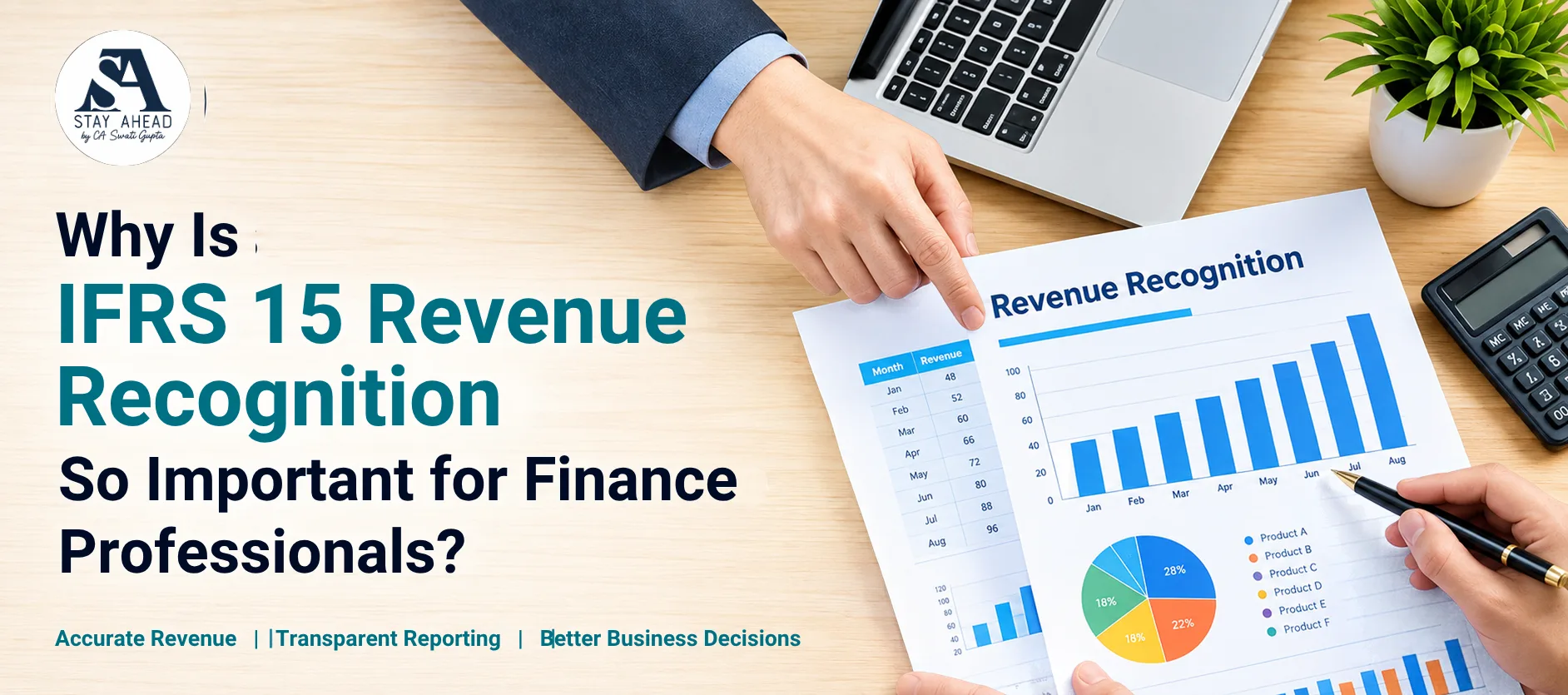
A practical course should walk you through the standards that keep coming up in real audit and reporting work. Think IAS 1 on presentation of financial statements, IFRS 9 on financial instruments, IFRS 15 for revenue from contracts, IFRS 16 on leases, IAS 36 for impairment, and IFRS 3 on business combinations. None of these should feel like dry rulebooks. The better courses explain them through worked examples — how revenue recognition actually shifts under IFRS 15 for a software company, say, or how IFRS 16 quietly reshapes a company’s entire balance sheet once leases move on it.
Practical Case Studies and Numerical Application
Reading about a standard and actually applying it are two completely different skills. A course built around case studies, journal entries, and disclosure examples will get you far more ready for real client work — or for something like DipIFR — than one that stays purely theoretical the whole way through.
Why Online Beats Classroom Training for This Particular Subject?
There’s a reason online learning has largely overtaken classroom coaching for certifications like this one.
You’re not quitting your job or burning leave to build this skill — most IFRS online courses run in self-paced modules, so early mornings, lunch breaks, or a lazy Sunday afternoon all work fine. Cost matters too. Classroom coaching in a metro city usually comes with travel, accommodation if you’re commuting from another city, and higher fees overall, while online courses tend to cost less for roughly the same depth of syllabus.
Then there’s the replay factor. Concepts like deferred tax under IAS 12, or financial instrument classification under IFRS 9, are not things anyone grasps the first time around. Being able to rewatch a recorded lecture beats a one-off classroom session you can never revisit. And finally, the good online programs are usually run by people who’ve actually worked with IFRS in practice, not academics teaching from a textbook — and that difference shows up constantly in how examples get explained.
How to Choose the Right IFRS Online Course?
With so many options floating around, here’s a rough filter worth applying before you enrol.
Start with the faculty’s background. Someone with real audit or IFRS implementation experience explains things very differently from someone who’s only ever taught from a book — look for trainers with a Chartered Accountancy background and genuine hands-on exposure. Next, check whether the course actually goes standard by standard, rather than clumping everything into vague modules like “Financial Instruments Overview.” You want depth that’s ideally aligned with how DipIFR or Cert IFRS exams are structured, even if you have zero plans to sit that exam yourself.
Doubt support matters more than people expect. IFRS has genuinely tricky corners — consolidation adjustments, deferred tax on business combinations — and a course offering doubt-clearing sessions or mentor access is worth far more than one that just dumps videos on you and vanishes. Last thing: read actual reviews, the kind that talk about teaching clarity and practical relevance, not the generic five-star ratings with nothing behind them.
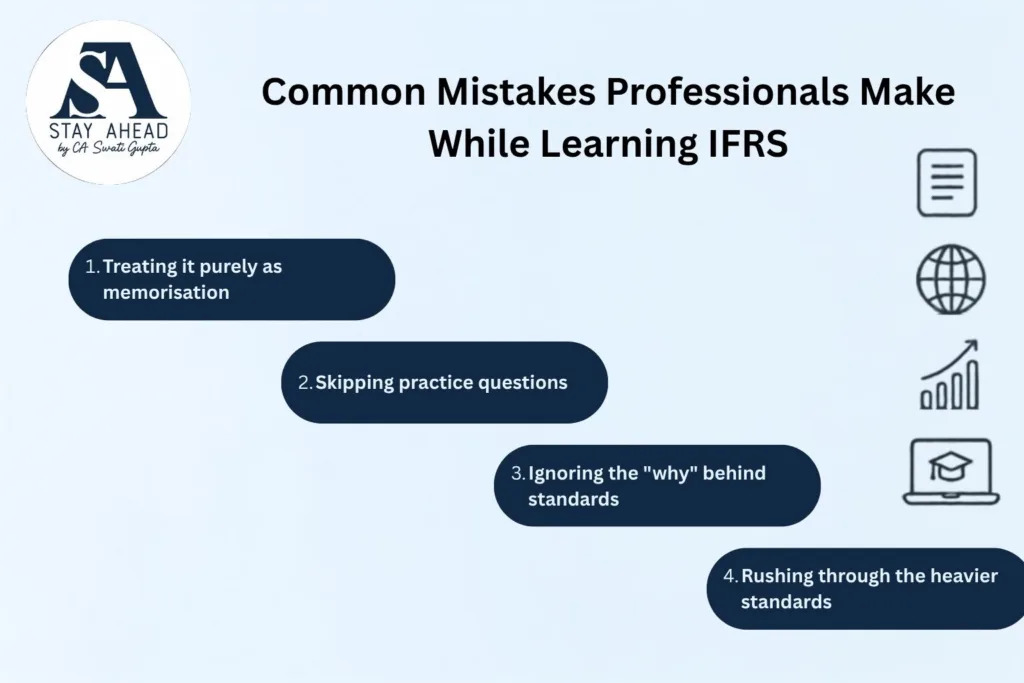
Common Mistakes Professionals Make While Learning IFRS
A few patterns show up again and again with people who struggle, even after paying for a decent course:
- Treating it purely as memorisation – IFRS rewards understanding the logic behind a standard far more than memorising its definitions word for word.
- Skipping practice questions – Watching videos passively without solving numerical problems leaves your application skills shaky at best.
- Ignoring the “why” behind standards – Once you understand a standard’s objective, remembering its requirements gets a lot easier.
- Rushing through the heavier standards – IFRS 9 and IFRS 17 need more time than the rest. Treat every standard the same and progress slows down fast.
Avoid these four and you’ll likely retain far more from any IFRS online course you take.
Why Choose CA Swati Gupta?
If you’re still deciding where to actually take your IFRS online course, this is where CA Swati Gupta stands apart from most generic online programs floating around. The course isn’t theory lifted straight from a textbook — it’s shaped by real, practical exposure to IFRS reporting, taught in a way that stays easy to follow even if you’re returning to accounting concepts after a gap.
Faculty With Real-World IFRS Experience
CA Swati Gupta teaches from practice, not just from academic notes, which is exactly why even the trickier standards — financial instruments, business combinations, take your pick — end up far easier to actually internalise.
Structured, Standard-by-Standard Learning
Rather than vague overviews, the course moves standard by standard, building a solid foundation before you’re pushed into the more complicated corners of IFRS.
Doubt Support That Actually Works
Learners get real support when something doesn’t click, instead of being left to figure out a confusing standard alone after a recorded video ends.
Flexible Learning That Fits Around Your Job
Working CA, finance manager, or a student prepping for DipIFR — whatever your situation, the course is built to slot into your schedule rather than demand you rearrange your life around it.
At the end of the day, choosing CA Swati Gupta‘s IFRS online course means learning from someone who understands both the standards themselves and how professionals actually use them at work. Which, honestly, is the whole point of taking a course like this in the first place.
Frequently Asked Questions
1. Is an IFRS online course worth it for someone already working as an accountant?
Yes, especially if your work touches multinational clients, consolidated financials, or foreign subsidiaries. IFRS knowledge often ends up being the differentiator during appraisals and interviews for global finance roles.
2. How long does it typically take to complete an IFRS online course?
Most self-paced IFRS online courses take somewhere between 6 and 10 weeks, depending on how many hours you can put in weekly and how deep the course goes into practical case studies.
3. Do I need a strong accounting background before starting an IFRS online course?
A basic grasp of financial statements and accounting principles helps, but a well-structured course should build up from the fundamentals anyway before moving into the advanced standards.
4. Is IFRS the same as Ind AS?
Close, but not identical. Ind AS is India’s version of IFRS, adapted with certain carve-outs to suit local regulatory requirements. Learn IFRS properly and Ind AS becomes far easier to pick up.
5. Can an IFRS online course help with clearing ACCA’s DipIFR exam?
Yes, provided it’s structured around the actual DipIFR syllabus with standard-wise coverage and enough practice questions — it can double up as solid exam prep even if that’s not your primary reason for enrolling.