
Ask any finance controller what changed their workload the most in recent years, and leases will probably come up before anything else. IFRS 16 leases didn’t just tweak a disclosure note here and there — it rewrote how companies present one of their biggest financial commitments. And that shift meant accountants needed a fairly different set of skills, not just a new rulebook to flip through.
So why does this matter so much, and what does “handling it well” actually look like in practice? That’s what this piece digs into.
Why IFRS 16 Leases Matters for Financial Reporting
It Closes the Off-Balance-Sheet Gap
Before this standard came along, a company could lease a hundred properties or an entire vehicle fleet and show barely any of it as debt. Analysts had to dig through footnotes and make educated guesses just to figure out what a business actually owed. That’s changed now — lessees recognise a right-of-use asset and a lease liability for almost every lease, which gives anyone reading the statements a much truer picture. If you’re building this skill from scratch, a structured DipIFR online course is usually the fastest way in, since leases show up heavily in that syllabus.
It Improves Comparability Between Companies
Here’s a problem the old rules created: two companies doing the same thing economically — one buying assets outright, the other leasing them — could look completely different on paper. The buyer seemed more leveraged; the lessee looked cleaner, even though nothing about their underlying risk was different. Bringing almost all leases onto the balance sheet fixed that mismatch, at least mostly.
It Affects Key Financial Metrics
Recognising lease liabilities changes EBITDA, debt ratios, asset turnover — the works. Lease payments used to sit as one clean operating expense; now they’re split into depreciation and interest, which tends to push EBITDA up and shifts when expenses actually hit the P&L. That’s not a footnote-level detail for lenders running covenant tests — it’s central to how they judge whether a company’s finances are healthy. Getting comfortable with these calculations is exactly what an IFRS online course should be building toward, ideally through worked numbers rather than slides.
It Strengthens Corporate Governance and Accountability
Forcing leases onto the balance sheet also puts more pressure on management to actually track and disclose these commitments properly, instead of letting them sit quietly in a note nobody reads. Boards and audit committees get real visibility now, which — whatever else you think about the standard — is probably a good thing.
What Skills Do Accounting Professionals Actually Need Here?
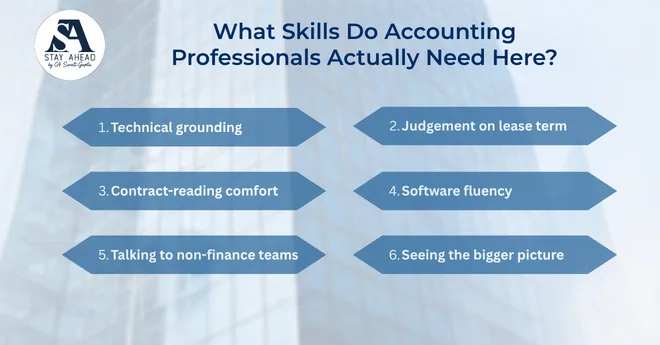
Knowing the theory is step one. Applying IFRS 16 leases well takes a mix of technical know-how, judgement, and honestly, some patience with contracts and spreadsheets. A decent financial reporting course online usually covers this blend rather than teaching leases as some isolated, standalone topic.
Technical grounding
You need to actually know how to calculate present value of lease payments, pick a defensible discount rate, and measure the right-of-use asset and liability correctly. Skip this, and everything after it is guesswork.
Judgement on lease term
Deciding whether a renewal option should count toward the lease term isn’t a formula — it depends on business intent, past behaviour, and what’s economically sensible. And whatever you decide, it needs to be documented well enough to survive an audit question. A financial statements course that walks through presentation and disclosure in real detail helps a lot here.
Contract-reading comfort
Lease accounting starts with the actual contract — payment terms, escalation clauses, embedded leases hiding inside service agreements, non-lease components that need separating out. If you’re not comfortable reading contracts closely, this gets messy fast.
Software fluency
Nobody’s tracking 200 leases in a spreadsheet by hand anymore, or at least they shouldn’t be. Most teams now use dedicated lease software, and accountants need to know how to validate what it spits out, not just trust it blindly.
Talking to non-finance teams
Leases get signed by procurement, legal, operations — rarely finance first. So accountants need to be the ones chasing down new contracts early enough to classify them correctly, which means being able to explain, in plain language, why it matters.
Seeing the bigger picture
Lease accounting doesn’t stay in its lane — it touches covenant compliance, tax, and management reporting too. Treating it as an isolated technical exercise is how things get missed.
A Quick Real-World Example
Picture a retail chain with 150 store leases spread across different cities. Before this standard, those leases barely showed up on the balance sheet. After adoption, the finance team had to build a centralised lease register, work out incremental borrowing rates location by location, and recognise right-of-use assets and liabilities running into hundreds of crores. It wasn’t just an accounting exercise — it needed people who could handle data, coordinate across teams, and build a workable model under time pressure.
Where Professionals Still Trip Up
- Using inconsistent discount rates across business units, which quietly breaks internal comparability
- Missing embedded leases buried inside broader service or supply contracts
- Documenting judgement calls poorly, which becomes obvious the moment an auditor asks a follow-up question
- Treating this as a one-time project rather than something that needs upkeep every time a lease is signed or modified
Why Choose CASwatiGupta to Build These Skills
Given how much judgement this area actually demands, structured training genuinely helps — and that’s where caswatigupta stands out. Instead of treating leases as an abstract topic to memorise, the training leans on real contracts and worked calculations, the kind of thing you’d actually run into on the job. The goal isn’t reciting the standard back — it’s being able to apply IFRS 16 leases confidently when a messy real contract lands on your desk.
Conclusion
IFRS 16 leases reshaped financial reporting more than most standards have in the last decade, dragging leases out of the footnotes and onto the balance sheet where they belong. But knowing the standard on paper and applying it well are two different things — it takes technical precision, real judgement, some comfort with software, and the ability to work across departments who don’t speak “accounting.” Professionals who build that combination don’t just stay compliant; they become genuinely harder to replace. If you want to build that depth properly, caswatigupta is a solid place to start.
Frequently Asked Questions
1. Why was this leasing standard introduced in the first place?
Mainly to close a transparency gap — operating leases used to sit off the balance sheet, understating what companies actually owed.
2. Does it apply to every single lease?
Nearly all of them, yes. Short-term leases (12 months or under) and low-value assets can still be excluded, if a company chooses.
3. What trips companies up the most when applying it?
Usually it’s the data side — pulling together every lease contract across departments and applying consistent judgement on terms and discount rates.
4. Do accountants really need software training for this?
It’s not mandatory, but practically speaking, yes. Once you’re past a handful of leases, manual tracking stops being realistic.
5. How does this affect the ratios lenders care about?
It typically pushes up both assets and liabilities, which can shift leverage ratios, EBITDA, and covenant calculations — so it’s worth being able to explain clearly to whoever’s reading the numbers.