

If you’ve ever stared at a company’s balance sheet and felt like you were reading a different language, you’re not alone. Numbers on a page don’t mean much until someone teaches you how to read the story behind them. That’s exactly the gap a good financial statements course is designed to fill.
Whether you’re a commerce graduate hunting for your first finance job, a working professional trying to move into a core finance role, or a business owner who wants to stop nodding blankly during board meetings — understanding financial statements isn’t optional anymore. It’s the one skill that quietly separates people who “manage” finance from people who actually understand it.
In this guide, we’ll walk through what such a course actually covers, why it matters right now, who benefits most from it, and how to choose one that’s worth your time and money.
What Exactly Is a Financial Statements Course?
At its core, this kind of program teaches you how to prepare, read, and interpret the three (or four, depending on how you count) pillars of corporate reporting: the balance sheet, the profit and loss statement, the cash flow statement, and the notes to accounts that tie everything together.
A well-designed financial statements course goes further than definitions, though. It shows you how these statements connect to each other, why a profitable company can still run out of cash, and how small accounting choices — like how depreciation is calculated — can change the entire picture an investor sees.
Think of it less like a textbook chapter and more like learning to read between the lines of a story that companies tell every quarter.
Why Financial Statements Skills Matter More Than Ever
A decade ago, financial reporting was largely the domain of accountants and auditors. That’s changed. With Ind AS and IFRS convergence, increased regulatory scrutiny, and investors demanding more transparency, the ability to read and analyse financial statements has become a core business skill — not a niche accounting one.
Recruiters across finance, banking, equity research, consulting, and even marketing and operations roles now expect candidates to comfortably discuss revenue recognition, working capital, and profitability ratios. A structured financial statements course gives you that vocabulary and confidence in a fraction of the time it would take to piece it together on your own.
Who Should Enroll?
You don’t need to be a chartered accountant to benefit here. In practice, this kind of training tends to attract a fairly diverse crowd.
Commerce and Finance Students
For students preparing for CA, CS, CMA, or an MBA in finance, a financial statements course builds the practical foundation that theory-heavy college syllabi often skip.
Working Professionals in Non-Finance Roles
Product managers, HR leaders, and marketing heads increasingly need to interpret P&L statements to justify budgets and measure impact. The right course helps them speak the same language as their finance teams.
Entrepreneurs and Business Owners
If you’re running a business, your financial statements aren’t paperwork for your accountant — they’re a health report on your company. Founders who invest in this learning tend to make faster, more confident decisions about pricing, hiring, and fundraising.
Aspiring Analysts and Investors
Equity research analysts, credit analysts, and even retail investors rely heavily on financial statement analysis to value companies and assess risk.
What You’ll Actually Learn
Course structures vary, but most credible programs cover the following ground.
Reading the Balance Sheet
You’ll learn to distinguish assets from liabilities, understand what shareholders’ equity really represents, and spot red flags like ballooning receivables or hidden debt.
Understanding Profit & Loss Statements
This section usually covers revenue recognition, cost classification, and the difference between operating profit and net profit — details that matter enormously when comparing two companies.
Cash Flow Analysis
Many learners find this the most eye-opening part of any financial statements course, because it reveals why “profit” and “cash in the bank” are two very different things.
Ratio Analysis and Interpretation
Liquidity ratios, solvency ratios, profitability ratios — a good program typically ties these together so you can benchmark a company against its peers, not just look at numbers in isolation.
Notes to Accounts and Disclosures
This is where the real detail lives. A quality financial statements course trains you to actually read the fine print instead of skipping past it.
IFRS, Ind AS, and Why the Framework You Learn Matters
One thing that often surprises beginners is that financial statements aren’t prepared the same way everywhere. India follows Ind AS, which is largely converged with IFRS but still has notable differences in areas like revenue recognition, financial instruments, and leases.
If you’re planning to work with multinational companies, or you’re preparing for a global finance career, it’s worth spending time on a detailed comparison of IFRS and Ind AS before you go deeper into either framework. Knowing where the two standards align — and where they don’t — will save you a lot of confusion later.
Building on the Basics: From Fundamentals to Certification
Once you’ve got the fundamentals down, many learners choose to specialise further based on which reporting framework matters most for their career path. If you’re aiming for roles in MNC finance teams, global audit firms, or companies reporting under international standards, a dedicated IFRS certification course is usually the natural next step after building your base with a general financial statements course.
A well-sequenced learning path usually looks like this: start with a strong financial statements course to build your fundamentals, then move deeper into whichever standard your target role actually demands.
On the other hand, if your work revolves around Indian companies, listed entities, or filings that follow domestic reporting requirements, it makes more sense to follow up with a focused Ind AS certification course instead — since that’s the framework you’ll be applying on a day-to-day basis.
How to Choose the Right Course
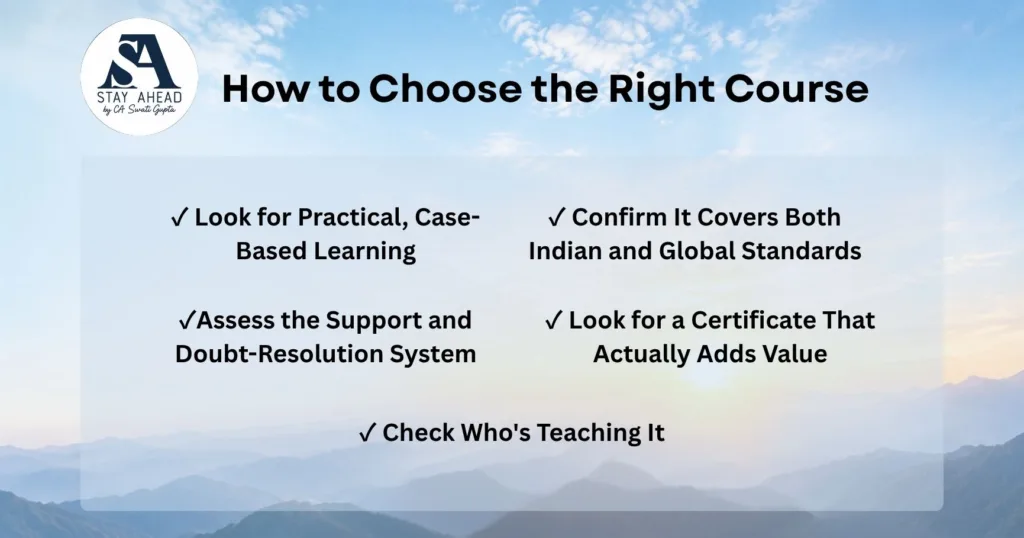
Not all programs are created equal, and it’s easy to get swayed by flashy marketing. Here’s what’s actually worth checking before you enroll.
Look for Practical, Case-Based Learning
A program that only covers theory won’t help much when you’re staring at a real annual report. Look for one that uses actual company filings as case studies.
Check Who’s Teaching It
Ideally, your instructor should have real-world experience in accounting, audit, or financial analysis — not just someone reading off slides.
Confirm It Covers Both Indian and Global Standards
Given how interconnected businesses are today, a program that only touches on one reporting framework leaves you with half the picture.
Assess the Support and Doubt-Resolution System
Financial concepts can get confusing fast. A course with live doubt sessions or mentor access tends to produce far better outcomes than a purely recorded, self-paced format.
Look for a Certificate That Actually Adds Value
A recognised certificate at the end of the program can strengthen your resume, especially if it’s backed by a credible instructor or institution.
Why Choose CA Swati Gupta
If you’re weighing your options, here’s the honest pitch: caswatigupta’s financial statements course is built for people who want more than definitions — it’s designed to make you genuinely confident reading a company’s numbers, not just memorising formulas before an exam.
Practical, Experience-Led Teaching
Every module in this program is grounded in real audit and accounting experience, not just textbook theory, so you learn how professionals actually approach financial statements in practice.
A Clear Path from Basics to Certification
Whether you’re starting fresh or planning to move on to standard-specific certification later, caswatigupta structures the learning journey so each step builds naturally on the last.
Personal Mentorship, Not Just Recorded Videos
Doubts get resolved directly, which makes a real difference when you’re trying to actually understand a concept rather than just get through a syllabus.
At the end of the day, a financial statements course is only as good as the person teaching it — and that’s the difference caswatigupta aims to make.
Frequently Asked Questions
1. Do I need an accounting background to join?
No. Most programs like this are designed to start from the basics, so students, working professionals, and business owners with no prior accounting background can follow along comfortably.
2. How long does a typical program like this take to complete?
This varies by provider, but most structured programs run anywhere from a few weeks to a couple of months, depending on how deep the course goes into ratio analysis and standard-specific topics.
3. Is this useful if I already work in finance?
Yes. Many working professionals take one specifically to sharpen their analytical skills or to prepare for a move into roles like equity research, credit analysis, or financial planning.
4. What’s the difference between this and a standard-specific certification?
This kind of program covers the fundamentals of reading and analysing statements broadly, while a certification course dives deeper into the technical accounting standards themselves.