

What exactly happens to the gains and losses that never quite make it to your profit and loss statement? That question trips up a lot of accounting students and even a few working professionals, and the answer almost always leads back to one line item: other comprehensive income. If you have ever stared at a balance sheet and wondered why certain unrealized gains don’t show up where you expect them to, you are not alone.
Other comprehensive income, often shortened to OCI, is one of those topics that sounds intimidating on paper but becomes a lot more manageable once you see it in context. It sits quietly between net income and total equity, picking up items that affect a company’s financial position without running through the income statement in the usual way. For anyone building a career in IFRS or Ind AS reporting, getting comfortable with this concept is not optional — it shows up constantly in real financial statements, exam papers, and client conversations alike.
Before we go further, it helps to connect this to something many learners already know: revaluation surpluses recognized under IAS 16 Depreciation rules are a classic example of an item that bypasses the income statement and lands directly in OCI. If you have ever revalued a piece of property, plant, or equipment above its carrying amount, that gain typically doesn’t touch profit or loss at all — it goes straight into a revaluation reserve within equity.
What Is Other Comprehensive Income?
So what is other comprehensive income, in plain terms? It is the collection of revenues, expenses, gains, and losses that a company has not yet “realized” in the traditional accounting sense, but which still need to be recorded because they affect the company’s net worth. These items are excluded from net income because they haven’t been settled through an actual transaction, yet accounting standards require that they be disclosed somewhere for the financial statements to present a true and fair view.
This is also where things get interesting for lease accounting. Many professionals studying IFRS 16 Leases often ask whether foreign-currency lease liabilities or related translation differences can create OCI entries, and the short answer is yes, in specific circumstances involving foreign operations. Understanding how lease standards interact with comprehensive income reporting is becoming an increasingly common interview question for finance professionals working with multinational clients.
Key Components of Other Comprehensive Income
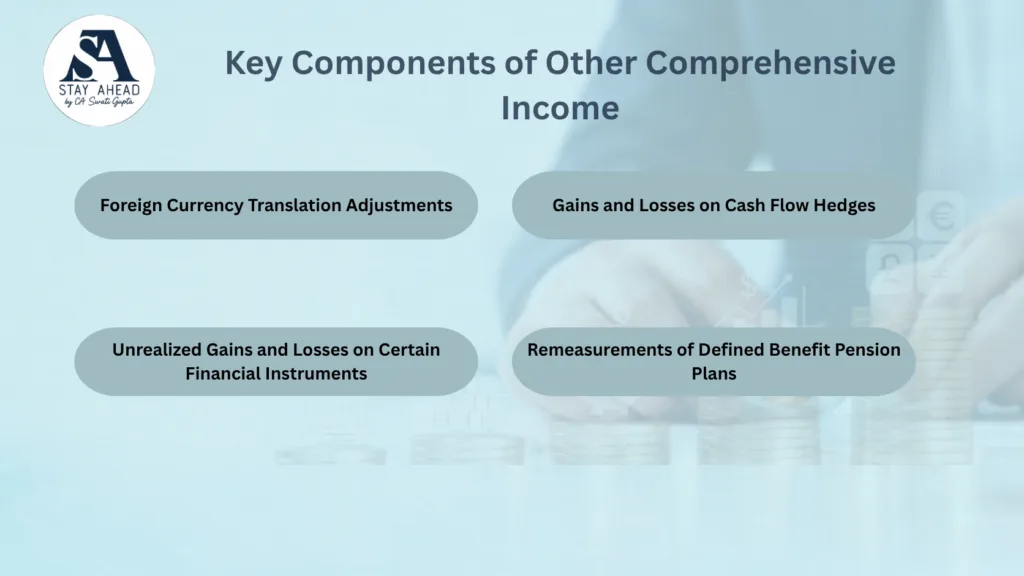
Let’s break down the main components you’ll typically find within this part of the financial statements:
It’s worth pausing here to note how this differs from topics like Revenue Recognition Accounting, where the focus is entirely on when and how revenue hits the income statement. OCI operates almost in parallel — it’s not about recognizing revenue at all, but about capturing value changes that standards have decided shouldn’t distort the operating results reported through net income.
Foreign Currency Translation Adjustments
When a parent company consolidates financial statements of a foreign subsidiary, the subsidiary’s assets, liabilities, and income are translated into the parent’s reporting currency. Any resulting gain or loss from this translation doesn’t hit net income; instead, it sits in OCI until the foreign operation is disposed of.
This treatment is a good reminder of why standards go to such lengths for consistency — much like the structured approach students run into when studying IFRS 15 Revenue Recognition, where recognition timing follows a defined five-step model rather than being left to judgment.
Unrealized Gains and Losses on Certain Financial Instruments
Investments classified as fair value through OCI (FVOCI) under IFRS 9 generate unrealized gains or losses that are reported here rather than in the income statement, preserving a cleaner picture of operating performance.
Remeasurements of Defined Benefit Pension Plans
Actuarial gains and losses arising from changes in assumptions used to value pension obligations are recognized here too, reflecting the long-term, often volatile nature of these estimates.
Gains and Losses on Cash Flow Hedges
The effective portion of gains or losses on instruments used to hedge future cash flows is deferred in this section until the hedged transaction actually affects profit or loss.
Accumulated Other Comprehensive Income: The Running Total
Once you understand the individual components, the next logical question is how they accumulate over time. This brings us to accumulated other comprehensive income, which is simply the running total of all OCI items recognized since the company began reporting them, net of any amounts reclassified to profit or loss. Unlike net income, which resets each period through closing entries, this balance carries forward on the balance sheet as a distinct component of equity.
So, what is accumulated other comprehensive income in practical terms? Picture it as a holding account within shareholders’ equity. Each period, the current period’s OCI is added to (or subtracted from) the prior balance, and the cumulative figure is presented separately from retained earnings. This separation matters because it tells readers of the financial statements which portion of equity came from actual trading performance versus unrealized valuation changes.
How Comprehensive Income and Other OCI Items Flow Into the Financial Statements
A natural question that comes up alongside this is how comprehensive income and other OCI items are presented together in the financial statements. Under IFRS, companies can choose to present comprehensive income either in a single statement that combines profit or loss with OCI, or in two separate but linked statements. Either way, the total comprehensive income figure — net income plus OCI — gives stakeholders a fuller picture of how a company’s financial position changed during the period, beyond what net income alone can show.
This same philosophy of consistency runs through comprehensive income reporting as a whole — standards exist precisely so that gains and losses, whether realized or not, are captured transparently rather than left out of the picture entirely.
A Real-World Example
Suppose a company holds an investment in another entity’s debt instruments, classified at fair value through OCI. During the year, the fair value of this investment rises by ₹5,00,000. This gain doesn’t appear in the income statement because it hasn’t been sold; instead, it flows through other comprehensive income and adds to the accumulated balance in equity. If the company later sells the investment and realizes the gain, the amount may then be reclassified into profit or loss, depending on the applicable standard.
Why Does This Matter in Practice?
Why does any of this matter beyond passing an exam? Because investors, lenders, and auditors increasingly look at total comprehensive income as a more complete measure of financial performance. A company reporting strong net income while quietly absorbing large losses through OCI — say, from pension remeasurements or currency translation — may be in a less stable position than the income statement alone suggests. Professionals who can read and explain these nuances bring real value to employers and clients.
For students and working professionals preparing for IFRS or Ind AS certifications, other comprehensive income is a recurring theme across multiple standards, not an isolated topic. It touches property revaluation, financial instruments, employee benefits, and foreign operations all at once, which is exactly why building a strong conceptual foundation here pays off across the rest of your studies.
Why Choose caswatigupta
Learning a concept like this from a textbook is one thing; learning it the way it actually appears in real financial statements and audit working papers is another. That’s where caswatigupta makes the difference. With structured IFRS and Ind AS training designed around practical application, caswatigupta helps students and professionals move past rote memorization and genuinely understand how standards connect to real-world reporting. Whether you’re preparing for a certification or trying to strengthen your day-to-day technical skills, caswatigupta’s courses are built to make complex topics like this one feel intuitive rather than intimidating.
Frequently Asked Questions
1. What is other comprehensive income in simple terms?
It refers to gains and losses that affect a company’s equity but are not included in net income because they haven’t been realized through an actual sale or settlement, such as unrealized investment gains or currency translation adjustments.
2. How is OCI different from net income?
Net income reflects a company’s realized operating performance for the period, while OCI captures unrealized changes in value, like pension remeasurements or fair value adjustments, that bypass the income statement but still affect total equity.
3. What is accumulated other comprehensive income?
It is the cumulative balance of all OCI items recognized over time, presented as a separate component within shareholders’ equity on the balance sheet.
4. Why do some gains and losses skip the income statement entirely?
Accounting standards route certain gains and losses through OCI instead of net income because they are considered unrealized or temporary, and including them directly in profit or loss could distort a company’s true operating performance.
5. Can items in OCI ever move to the income statement later?
Yes. Certain items, like gains on cash flow hedges or disposed foreign operations, are reclassified from OCI into profit or loss once the underlying transaction is completed, a process known as recycling.