
Ask ten finance students what “revenue” means, and you’ll probably get ten confident, slightly-wrong answers. It sounds like the simplest line item on a P&L — money coming in — until you actually sit with a real contract and try to figure out when that money should be recorded. That’s where IFRS 15 revenue recognition comes in, and honestly, it trips up far more professionals than it should.
I’ve seen experienced accountants get this wrong not because they don’t understand accounting, but because they’re still thinking in terms of invoices and bank statements instead of “when did control actually transfer to the customer.” That one shift in thinking is basically the entire point of the standard. If you’re a finance student, a working professional, or someone chasing a global accounting qualification, this isn’t a topic you can skim past — it shows up everywhere, from exam papers to audit queries to boardroom discussions about why quarterly numbers look the way they do.
What Is IFRS 15 Revenue Recognition, Exactly?
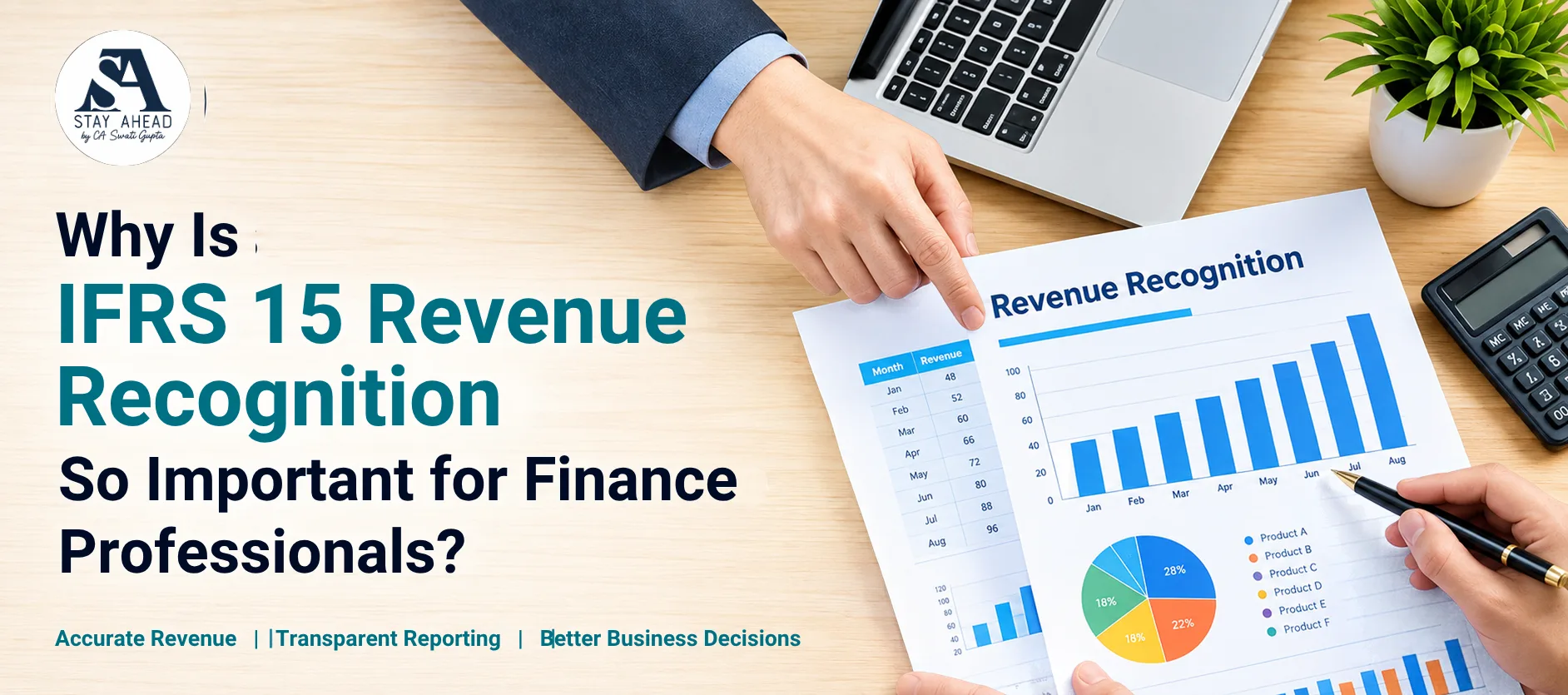
Strip away the jargon, and IFRS 15 revenue recognition is simply the rulebook for deciding when and how much revenue a business should record from its contracts with customers. It replaced two older, messier standards — IAS 18 and IAS 11 — which, frankly, left too much wiggle room. Two companies selling near-identical products could book revenue completely differently under the old rules, and nobody could really say who was “wrong.”
So the standard-setters did something sensible: they built one principle-based framework and applied it everywhere — software, construction, telecom, retail, doesn’t matter. The core idea is this: revenue gets recognised when control of a good or service passes to the customer. Not when the invoice goes out. Not when the cash lands. Control. That single word changes a lot of accounting decisions.
Why Did We Even Need This Standard?
Here’s the thing — before IFRS 15, companies had a fair bit of room to interpret revenue rules in their own favour. Most used that flexibility responsibly. A few didn’t, and those few caused real damage: inflated earnings, embarrassing restatements, investors left wondering what they could actually trust.
Regulators wanted consistency — something comparable across industries and across borders, so a software company in Bangalore and a construction firm in Berlin would be applying the same logic. That consistency is really what IFRS 15 revenue recognition was built to deliver.
The Five-Step Model, Broken Down
This is the part everyone eventually has to memorise, but it’s worth actually understanding rather than just reciting.
Step 1: Identify the Contract
A contract isn’t necessarily a fifty-page legal document with signatures and a notary stamp. It just needs to create enforceable rights and obligations — sometimes that’s written, sometimes it’s verbal, sometimes it’s just how the business has always operated with a particular customer.
Step 2: Identify the Performance Obligations
What is the business actually promising here? Sell a machine, and also agree to service it for two years? That’s two separate promises, not one bundled sale — and each gets treated on its own terms.
Step 3: Determine the Transaction Price
This is where discounts, rebates, bonuses, and financing arrangements start complicating what should be a simple number.
Step 4: Allocate the Price
If there’s more than one obligation in the contract, the total price has to be split across them — usually based on what each part would sell for on its own. This step involves more judgement than most people expect.
Step 5: Recognise Revenue
Finally — revenue gets recorded either all at once (think: product delivered) or gradually over time (think: a three-year construction project), depending on how control actually transfers.
A Real-World Example
Take a software company selling an annual subscription that comes bundled with onboarding support. Under the old rules, some businesses would have just booked the whole fee the moment the deal closed. Under IFRS 15 revenue recognition, that same contract gets pulled apart — the subscription revenue spreads evenly across twelve months, while onboarding, if it’s genuinely a separate service, might get recognised upfront once it’s delivered.
It’s a small example, but it captures exactly why this standard exists — revenue should reflect how value actually flows to the customer, not how quickly the invoice was sent.
Where Companies Usually Go Wrong
A few mistakes show up again and again, even at well-run companies:
- Treating a bundled contract as one single obligation when it’s really two or three distinct promises.
- Ignoring variable consideration — bonuses, penalties, rebates — instead of estimating and constraining them properly.
- Recognising revenue too early, before control has genuinely passed, or too late, sitting on revenue that’s already been earned.
- Skimping on disclosures. IFRS 15 expects detailed notes on judgement calls and remaining obligations, and this is often the first thing auditors push back on.
Honestly, mastering IFRS 15 revenue recognition is less about memorising the five steps and more about training yourself to notice these judgement calls before an auditor does.
How This Standard Actually Shapes Financial Statements
This isn’t some footnote buried in the annexures — it changes the shape of the income statement itself. Shift revenue timing, and you shift reported profit, gross margins, even how analysts value the company. For businesses running subscriptions, long-term contracts, or bundled deals, this one standard can make a quarter look dramatically different on paper, even when nothing about the underlying business has changed.
That’s exactly why investors and auditors lean so heavily on revenue recognition policies — it’s often the single biggest area of judgement in the entire financial statements.
Building Real Expertise, Not Just Textbook Knowledge
Reading a blog post like this gets you started, but real fluency comes from working through messy, real contracts — the bundled ones, the ones with variable pricing, the ones that run over three years. That’s the kind of depth a solid financial reporting course online is actually built for — not theory dumps, but case studies you’d genuinely run into on the job.
If you’re working toward a globally recognised qualification, a properly structured DipIFR online course covers this standard alongside every other major IFRS topic, with the exam-focused clarity that self-study rarely gives you. And if your goal is simpler — just getting sharper at your day job — a good IFRS online course or a focused financial statements course can connect these rules directly to statements you’re already working with, instead of leaving them as abstract theory.
Why Choose CA Swati Gupta
You can read about IFRS 15 revenue recognition all day, but scattered blog posts and PDFs only take you so far. What actually moves the needle is learning from someone who’s taught this material for years, walked students through real contract scenarios, and knows exactly where people get stuck.
That’s what caswatigupta brings to the table — clear explanations, practical examples, and a teaching style built around how these standards show up in actual financial statements, not just how they read in a textbook. If you’re serious about getting confident with IFRS 15 revenue recognition and the wider IFRS framework, studying under caswatigupta means structured guidance, real doubt-clearing support, and a curriculum built around what genuinely matters for exams and practice. That’s the combination that’s made caswatigupta a name students and professionals keep coming back to.
Frequently Asked Questions
1. What does IFRS 15 revenue recognition actually require companies to do?
It requires revenue to be recognised when control of a good or service passes to the customer — following a five-step model, rather than simply going by invoicing or cash receipt.
2. Which older standards did IFRS 15 replace?
It replaced IAS 18 (Revenue) and IAS 11 (Construction Contracts), pulling their guidance — along with a few related interpretations — into one unified framework.
3. Does this standard apply across all industries?
Yes. It was deliberately built to be industry-neutral, so it applies just as much to software and telecom as it does to construction and retail.
4. What trips companies up the most with this standard?
Usually two things: splitting contracts into the right performance obligations, and correctly estimating variable consideration like rebates or bonuses.
5. What’s the fastest way to actually get good at applying this, not just reading about it?
Structured learning — a real course with case studies and expert feedback — beats self-study almost every time, especially for a topic this judgement-heavy.