
If you’ve ever stared at a set of financial statements prepared under Ind AS and felt a little lost, you’re not alone. Indian Accounting Standards can feel dense, technical, and, honestly, a bit intimidating when you’re learning them on your own from bare-bones text.
That’s exactly where an Ind AS course online changes the game. Instead of wading through circulars and standard-setter language by yourself, you get a structured path — one that breaks down complex standards into concepts you can actually apply at your desk on a Monday morning.
Whether you’re a CA student preparing for exams, a working professional handling financial statements, or someone eyeing a shift into corporate reporting roles, the right Ind AS course online doesn’t just teach you the rules. It teaches you how to think like someone who prepares, reviews, and defends financial statements for a living. That shift in thinking is what actually strengthens your financial reporting skills — and it’s what this article is about.
Why Ind AS Knowledge Matters More Than Ever ?
Ind AS isn’t an optional add-on to your accounting knowledge anymore. It’s the backbone of financial reporting for listed companies, large private entities, banks, NBFCs, and insurance companies across India.
The Shift From Traditional Accounting to Ind AS
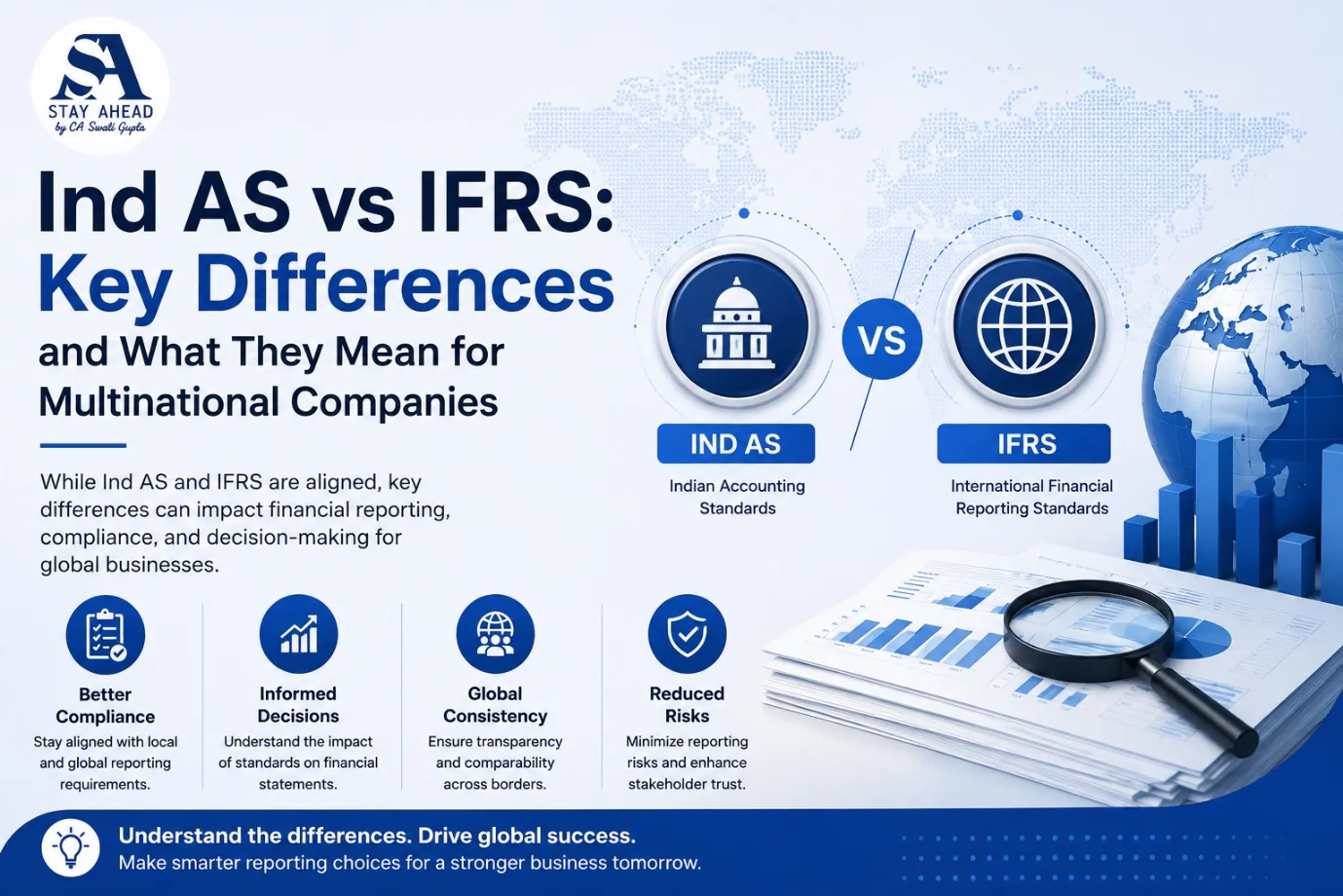
Traditional Indian GAAP was largely rule-based and transaction-focused. Ind AS, converged with IFRS, asks you to think in terms of principles — substance over form, fair value, and forward-looking estimates like expected credit loss. That’s a genuinely different mindset, and it’s why so many experienced accountants still find certain standards, like Ind AS 115 on revenue or Ind AS 109 on financial instruments, tricky at first.
Growing Demand for Ind AS-Trained Professionals
Recruiters at audit firms, corporates, and financial reporting teams are actively looking for candidates who can read a set of Ind AS financial statements and immediately spot what’s driving the numbers — lease accounting adjustments, deferred tax movements, or business combination entries. This demand isn’t limited to India either; because Ind AS mirrors IFRS so closely, professionals with strong Ind AS fundamentals often find it far easier to transition into IFRS or DipIFR-focused global roles later on.
Core Financial Reporting Skills an Ind AS Course Online Builds
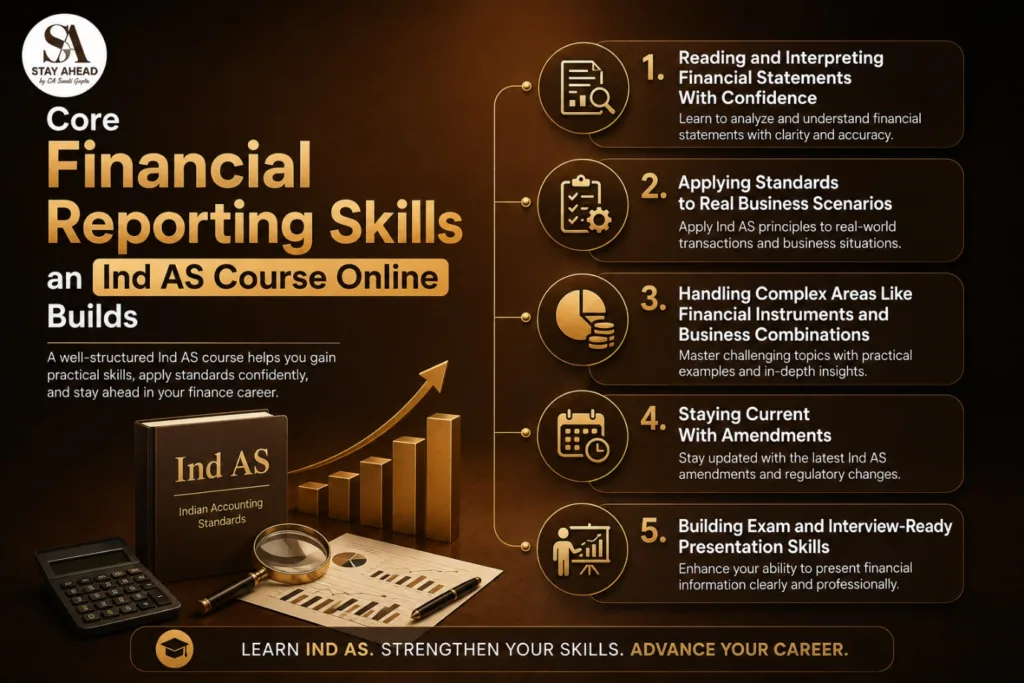
A well-designed Ind AS course online doesn’t just walk you through standard numbers one by one. It builds a set of practical skills that carry over into real work.
1. Reading and Interpreting Financial Statements With Confidence
Once you understand how Ind AS requires recognition, measurement, and disclosure, you stop reading financial statements passively. You start noticing why a company capitalised a cost instead of expensing it, or why a lease liability suddenly appeared on the balance sheet after Ind AS 116 came into effect.
2. Applying Standards to Real Business Scenarios
Theory only takes you so far. A course built around case studies and practical examples — think revenue recognition for a construction company, or fair valuation of investment property — helps you connect the standard’s wording to how it actually plays out in a company’s books.
3. Handling Complex Areas Like Financial Instruments and Business Combinations
Standards like Ind AS 32, 107, and 109 (financial instruments), and Ind AS 103 (business combinations) are where most learners lose confidence. A structured course breaks these into smaller, digestible pieces — recognition first, then measurement, then disclosure — so you build understanding layer by layer instead of getting overwhelmed.
4. Staying Current With Amendments
The Ministry of Corporate Affairs periodically notifies amendments to Ind AS. A good online course keeps its content updated, so you’re not learning outdated provisions and later having to unlearn them. This matters just as much for working professionals as it does for students preparing for exams.
5. Building Exam and Interview-Ready Presentation Skills
Knowing a concept and being able to present it clearly under exam or interview pressure are two different skills. Courses that include practice questions, doubt-solving sessions, and structured answer-writing practice help you convert your knowledge into marks — and into confident answers during interviews.
What to Look for in a Good Ind AS Course Online ?
Not every course delivers the same depth. Here’s what genuinely makes a difference.
Practical, Case-Study-Driven Teaching
Look for a course that uses real-world examples and numerical illustrations rather than just reading out the standard’s text. Concepts like deferred tax, impairment, and consolidation stick far better when you see them worked through step by step.
Faculty With Real Industry and Training Experience
There’s a noticeable difference between a course taught by someone who has only studied the standards and one taught by a trainer who has actually worked through Ind AS transitions, corporate trainings, and audits. Experience shows up in how examples are chosen and how doubts are resolved.
Doubt-Resolution and Mentorship Support
Ind AS has grey areas, and you will have questions the textbook doesn’t answer. A course that offers live doubt-solving, structured mentorship, or query resolution support helps you actually get unstuck instead of guessing your way through.
Flexibility to Learn at Your Own Pace
Whether you’re a working professional squeezing in study time after office hours or a student balancing multiple subjects, recorded lectures with lifetime access give you the flexibility to revisit tricky standards as many times as you need.
Updated Content Aligned With Recent Amendments
Always check that the course reflects the latest MCA notifications. Outdated material can do more harm than good, especially when you’re preparing for exams or applying standards at work.
How to Apply What You Learn in Real Work?
Completing a course is only half the journey. Here’s how to make the learning stick.
Practice With Real Financial Statements
Pick up annual reports of listed companies and try to identify Ind AS applications yourself — lease disclosures, revenue recognition policies, related party transactions. This kind of active practice reinforces classroom learning far better than passive revision.
Revisit Complex Standards Periodically
Standards like financial instruments and consolidation aren’t one-and-done topics. Revisit them every few months, especially before appraisals, exams, or when you’re handling a transaction that touches these areas.
Discuss Grey Areas With Peers or Mentors
Financial reporting often involves judgment calls. Discussing tricky scenarios with fellow learners or a mentor helps you see different interpretations and builds the kind of reasoning skill that textbooks alone can’t teach.
Conclusion
Strengthening your financial reporting skills isn’t about memorising standard numbers — it’s about learning to think through them the way an experienced professional would. That’s the difference a well-structured Ind AS course online makes: it turns a dense, rulebook-heavy subject into something you can genuinely apply with confidence, whether you’re preparing for exams, handling reporting at work, or aiming for global roles built on IFRS-aligned knowledge.
A Trainer Who Has Walked the Path
CASwatiGupta brings a rare combination to Ind AS and IFRS training — practical exposure through corporate trainings at firms like Grant Thornton, academic sessions at institutions like Shri Ram College of Commerce, and years of simplifying complex standards for CA and ACCA aspirants across India and abroad.
A Teaching Style Built Around Clarity
What sets learning with CA Swati Gupta apart is the emphasis on real-world application over rote learning. Standards are explained with practical examples, doubts are addressed directly in live sessions, and every concept is tied back to how it shows up in actual financial statements — not just how it reads in the standard.
A Community That Supports Your Growth
Beyond the course content, learners get access to structured guidance, doubt-resolution support, and a learning environment shaped by someone who understands exactly where students and professionals tend to struggle with Ind AS.
If you’re ready to move from simply knowing the standards to confidently applying them, an Ind AS course online with CA Swati Gupta is a solid place to start.
Frequently Asked Questions (FAQs)
1. Who should take an Ind AS course online?
CA and ACCA students preparing for financial reporting papers, working professionals in accounting, auditing, or finance roles, and anyone looking to strengthen their understanding of Indian Accounting Standards can benefit from an Ind AS course online.
2. How is Ind AS different from traditional Indian GAAP?
Ind AS is principle-based and converged with IFRS, focusing on fair value, substance over form, and forward-looking measurements like expected credit loss, whereas traditional Indian GAAP was largely rule-based and transaction-driven.
3. Can an Ind AS course online help with IFRS or DipIFR later?
Yes. Since Ind AS closely mirrors IFRS, a strong foundation in Ind AS makes it considerably easier to transition into IFRS-focused learning or pursue certifications like DipIFR for global career opportunities.
4. How long does it typically take to complete an Ind AS course online?
This varies by course structure, but most well-designed programs are built to be completed over a few weeks to a couple of months, depending on the depth of coverage and your own pace of learning.
5. Do I need prior accounting experience to join an Ind AS course online?
While some basic accounting knowledge helps, a good course is structured to take you from foundational concepts to advanced application, making it accessible for both students and experienced professionals.