
Somewhere in your first few years of working with financial statements, this question shows up. Usually it’s a colleague asking, or a client, or maybe it’s you staring at a consolidation worksheet at 11 pm wondering why the numbers won’t tie out. Ind AS vs IFRS — they look like cousins from a distance. Same family resemblance, same DNA in places. But sit two people down, one who’s only ever worked with Ind AS and one who’s only worked with IFRS, and hand them the same transaction, and you’ll sometimes get two different treatments. That gap is small on paper and enormous in practice.
I hear this question constantly — from working professionals prepping for DipIFR, from CA aspirants who can’t quite figure out why India didn’t just lift IFRS wholesale and use it as-is. Fair question. So let’s actually get into it, without drowning you in standard numbers you’ll forget by tomorrow.
Why Two Separate Frameworks Exist in the First Place ?
Here’s the short version: India never fully adopted IFRS. It built something adjacent to it — Ind AS — which borrows heavily from IFRS but bends around Indian company law, tax structure, and a few local business realities that the IASB never had to think about. You could call it IFRS with an Indian accent. The grammar is mostly the same; a few words are pronounced differently.
The Ministry of Corporate Affairs, working off ICAI’s recommendations, made deliberate carve-outs and carve-ins to line Ind AS up with the Companies Act. Not because Indian accountants disagreed with IFRS in principle, but because a standard written for 140+ countries can’t account for every domestic quirk. And if you’re dealing with multinational clients, or consolidating a group that has foreign subsidiaries, or simply eyeing a role outside India — you can’t treat these two as plug-and-play substitutes. A figure that’s perfectly correct under Ind AS might still need adjusting before it belongs in an IFRS consolidation.
The Core Differences — Minus the Jargon Overload
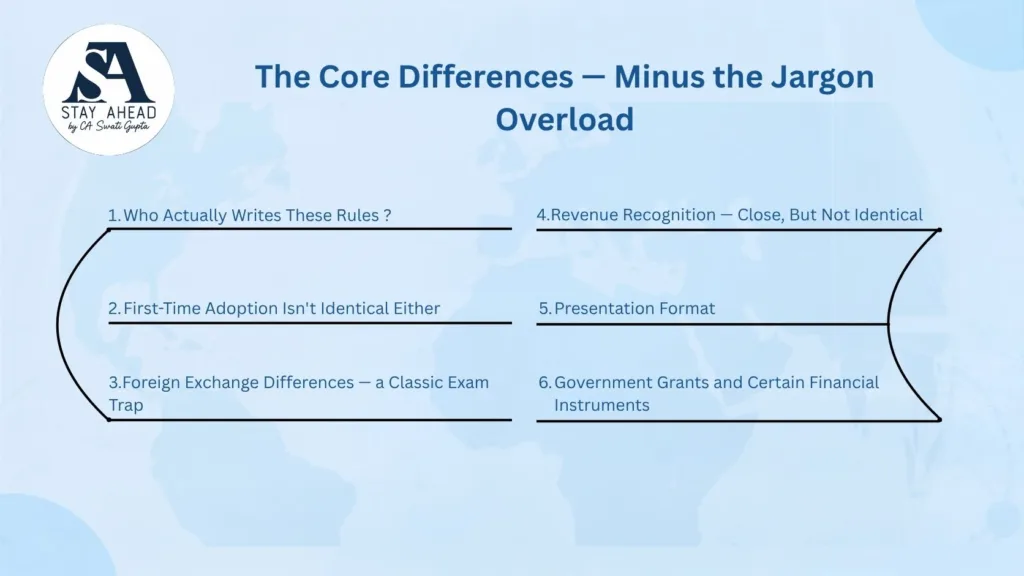
Who Actually Writes These Rules ?
IFRS comes from the IASB, and it’s designed with global uniformity in mind — used, in some form, across more than 140 countries. Ind AS is different. It’s notified by the MCA, built on ICAI’s groundwork, and shaped specifically to function inside India’s legal system. One is trying to speak to the whole world at once; the other is trying to work well within one country’s rulebook.
First-Time Adoption Isn’t Identical Either
Companies switching to IFRS for the first time follow IFRS 1, and it’s fairly uniform regardless of where the company is based. Ind AS 101 covers the same ground for Indian companies, but it carries extra exemptions — treatment of previous GAAP numbers, optional relaxations — that simply don’t exist on the IFRS side. Small print, but it changes outcomes.
Foreign Exchange Differences — a Classic Exam Trap
This one comes up in almost every DipIFR paper, so pay attention. IAS 21 wants exchange differences on long-term monetary items run straight through profit or loss. No detours. Ind AS, through certain transitional allowances, has historically let companies capitalize or defer part of those differences instead. That’s a genuine carve-out — not a rounding difference, an actual divergence in treatment.
Revenue Recognition — Close, But Not Identical
Ind AS 115 and IFRS 15 share almost the same five-step model, so on the surface this looks like a non-issue. Then you get into bundled contracts, real estate revenue, certain disclosure requirements — and the cracks appear. Ind AS has to remain consistent with Indian tax law, which occasionally pulls it in a slightly different direction than pure IFRS.
Presentation Format
IFRS doesn’t force a rigid layout on you. As long as your disclosures are complete, you have some flexibility in how the statements are structured. Ind AS has no such patience — Schedule III of the Companies Act, 2013 lays out exactly how the balance sheet and P&L should look. Pull up an Indian company’s annual report next to a UK-listed one sometime. Same underlying accounting logic, noticeably different presentation.
Government Grants and Certain Financial Instruments
A few more quiet differences live here — treatment of grants tied to non-monetary assets, classification rules for compound instruments. Again, these trace back to Ind AS trying to stay compatible with Indian tax treatment, something IFRS was never built to consider in the first place.
Why This Actually Matters, Beyond the Exam ?
I’ve trained well over a thousand professionals across DipIFR sessions and corporate IFRS workshops, and there’s a pattern that repeats almost every single time. Someone who’s spent years working comfortably in Ind AS assumes moving to IFRS will take a weekend of revision. It doesn’t. The underlying logic transfers fine — but the practical application around financial instruments, consolidation, revenue recognition needs genuine, focused study. Not a skim.
This becomes real, not theoretical, the moment you’re:
- Sitting inside a multinational preparing group accounts under IFRS
- Working toward DipIFR to make yourself more competitive for international roles
- Auditing companies that report under both frameworks for different purposes — Ind AS for MCA filing, IFRS for the overseas parent
- Chasing a finance role in the UK, the Middle East, or anywhere else that runs on IFRS
Where This Plays Out in Real Life ?
Picture an Indian subsidiary of a UK parent company. Locally, it reports under Ind AS to stay compliant with MCA requirements. But when the UK parent rolls up group numbers, those figures need translating into IFRS terms before they slot into the consolidated accounts. Get that translation wrong and errors creep quietly into the group financials — the kind that surface months later during an audit query. The professional who can do that translation cleanly, without hand-holding, tends to be the one who gets noticed when a cross-border role opens up.
So How Do You Actually Get Good at Both ?
Reading the standards side by side has its place, but honestly, it only takes you so far. What actually builds competence is running through real consolidation problems, restatement exercises, disclosure checklists — applying both frameworks to the exact same set of facts until the differences stop feeling abstract. That kind of practice is hard to replicate alone with scattered PDFs and outdated notes floating around the internet. It’s usually where a structured, mentor-led approach earns its cost back many times over.
Mistakes I See Again and Again
A handful of patterns show up almost every time someone tries to bridge IFRS and Ind AS on their own:
- Treating it as a simple standard-to-standard mapping exercise, without asking why the carve-outs exist in the first place
- Skipping disclosure differences because recognition and measurement “look close enough”
- Underestimating how much the Schedule III format versus IFRS’s flexibility actually shapes interpretation
- Not practicing enough consolidation and financial-instrument questions, which is exactly where the real divergence hides
Most of these get fixed the same way — structured practice, guided by someone who’s actually applied both frameworks on real engagements rather than only taught them from a textbook.
Quick Comparison Snapshot
| Aspect | IFRS | Ind AS |
|---|---|---|
| Issued by | IASB | MCA (based on ICAI recommendations) |
| Adoption | 140+ countries | India specific |
| Format of statements | Flexible | Schedule III prescribed |
| Forex on long-term monetary items | To P&L | Certain carve-outs allowed |
| First-time adoption | IFRS 1 | Ind AS 101, with India-specific exemptions |
Where This Leaves You ?
Ind AS vs IFRS was never really about which one wins. They exist for different reasons, and being fluent in one doesn’t automatically make you fluent in the other — that assumption trips up more professionals than anything else on this list. If you’re serious about a long-term career in financial reporting, the real advantage comes from being comfortable moving between both without needing a reference guide open on the side. That’s usually what separates someone who files compliant statements from someone who becomes the person everyone turns to for cross-border reporting.
Why Choose CA Swati Gupta ?
If your goal is real command over IFRS and Ind AS — not just enough to scrape through an exam, but enough to apply it confidently on an actual client engagement — that’s the gap caswatigupta was built to close. With more than five years spent simplifying financial reporting standards, and over a thousand professionals trained globally for DipIFR, caswatigupta’s approach stays grounded in what actually happens in practice, not just what’s written in the standard.
What Makes caswatigupta Different ?
- Genuine corporate background — sessions are shaped by real experience at firms like Grant Thornton, not lifted from a generic study guide.
- A mentor-led system, not a lecture series — built for people who are working full-time and can’t afford to pause their career to study.
- A track record you can actually check — over 1,000 students trained across countries, several of whom moved into senior finance roles right after certification.
- Credibility on both sides — academic workshops at institutions like Sri Ram College of Commerce, alongside corporate training delivered to established firms.
If you’re working toward DipIFR, trying to strengthen your Ind AS grip for statutory reporting, or simply aiming for a role that expects both — caswatigupta is where that clarity actually comes from, instead of another round of confusion.
FAQs
1. Is Ind AS the same as IFRS?
Not quite. Ind AS is converged with IFRS but carries specific carve-outs to stay aligned with Indian law, particularly the Companies Act and MCA rules. The core logic overlaps a lot; the fine print doesn’t always.
2. Which one’s more useful for a global career — Ind AS vs IFRS?
IFRS tends to carry more weight for international roles simply because of how widely it’s used. That said, if you’re working with or inside Indian companies, Ind AS knowledge is just as essential. Ideally, you’d want a working comfort with both.
3. If I already know Ind AS well, do I still need to study IFRS separately?
Yes, and it’s worth taking seriously. The foundations overlap, but areas like financial instruments, consolidation, and certain disclosures genuinely differ in application — differences that only show up once you’re actually working through them.
4. Where does DipIFR fit into all this?
DipIFR is ACCA’s globally recognized qualification focused specifically on IFRS. It’s particularly useful for professionals coming from an Ind AS background who want to formally prove their IFRS competence for international opportunities.
5. Realistically, how long does it take to get comfortable with both?
Depends on where you’re starting from, but most professionals with a solid Ind AS base can build real IFRS competence within a few months — assuming the practice is structured and consistent, not just occasional reading in spare time.