
Walk into almost any finance team today and you’ll hear the same complaint: the numbers don’t “talk” to each other anymore. A subsidiary in Dubai reports one way, the parent company in the US expects another, and somewhere in between, someone has to make sense of it all. That someone usually holds an IFRS Certification by ACCA — and honestly, it’s becoming less of a nice-to-have and more of a baseline expectation.
It’s not just another line to pad a resume with. For accountants who want to work with multinational companies, handle cross-border audits, or simply speak the same financial language as the rest of the world, an IFRS Certification has become close to essential. So let’s get into it — what this certification actually involves, why ACCA’s version carries so much weight, and where it can realistically take your career.
What Is IFRS Certification by ACCA?
IFRS Certification by ACCA is a structured qualification that tests and builds a professional’s understanding of International Financial Reporting Standards — the accounting rulebook used by more than 140 countries. ACCA designed this certification so working professionals could earn a credible, internationally accepted credential without hitting pause on their careers. Many learners start this journey through a well-structured ifrs online course, one that walks through each standard using real financial statements rather than dry theory.
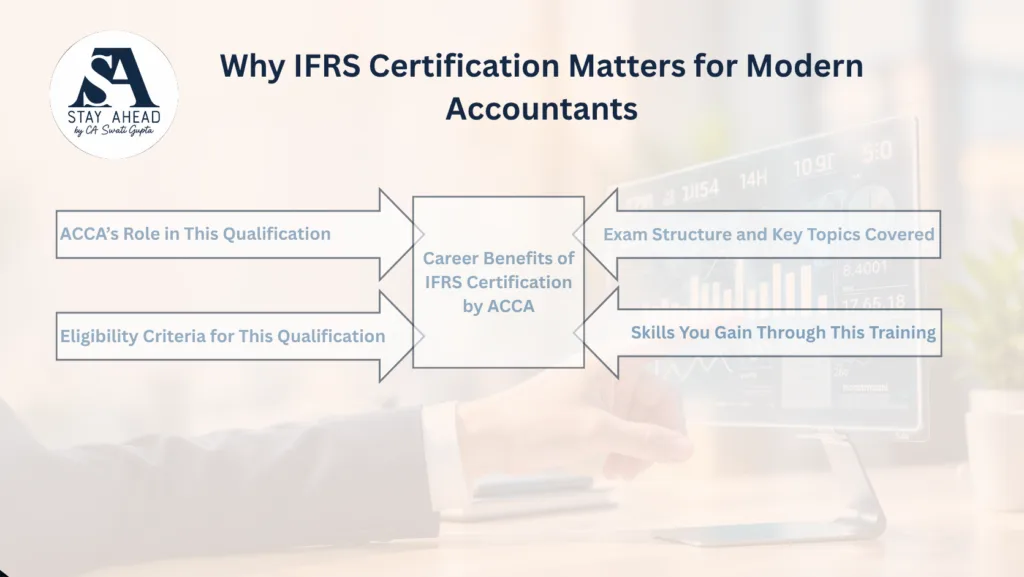
Why IFRS Certification Matters for Modern Accountants
Financial reporting stopped being a local affair a long time ago. A manufacturing company in India might raise funds from investors in Singapore, list on an exchange in London, and still report back to a parent company in Germany. Every one of those stakeholders expects numbers that mean the same thing, no matter where they were prepared. That’s precisely the gap an IFRS Certification is built to close.
Skip this grounding, and accountants often trip up when standards like lease accounting or revenue recognition get applied differently across jurisdictions. Take someone who’s actually studied IFRS 16 Leases in depth — they understand exactly why a simple office rental agreement can flip a company’s balance sheet under the new rules, something a locally trained accountant might miss altogether.
ACCA’s Role in This Qualification
ACCA has been building globally respected accounting qualifications for decades, and its approach to this credential shows that experience. Instead of a quick multiple-choice test, the qualification revolves around the Diploma in IFRS — DipIFR, as most people call it — which pushes candidates to apply the standards to real, messy case studies rather than tidy textbook examples.
This is exactly where structured guidance makes a difference. Candidates who enrol in an acca dipifr online course get access to practice case studies, examiner-style questions, and mentorship that mirrors what the real paper demands, instead of piecing together scattered material on their own.
Eligibility Criteria for This Qualification
Here’s the good part — ACCA has kept eligibility fairly accessible. Qualified accountants (CAs, CPAs, ACCA members, and the like), along with professionals who have at least two years of relevant accounting or audit experience and a recognised degree, can usually sit for the exam and walk away with their ifrs certificate. That makes the credential attainable for working professionals, not just fresh graduates with time on their hands.
Exam Structure and Key Topics Covered
The DipIFR paper is a single exam, but don’t let that fool you — it covers a lot of ground. Expect detailed questions on consolidated financial statements, financial instruments, impairment, and increasingly, trickier areas like insurance contracts. More candidates are now expected to understand how an IFRS 15 Revenue Recognition model actually plays out in practice, since revenue timing differences show up again and again in the paper.
If you’re leaning toward insurance, pay close attention to IFRS 17 — firms now lean on a dedicated ifrs 17 calculation engine just to handle the actuarial and discounting complexity the standard throws at them. Even outside insurance-heavy roles, examiners still expect you to grasp how standards like this reshape reported profits.
Skills You Gain Through This Training
The exam is really just the starting point. Pursuing this qualification sharpens skills employers actively go looking for — reading financial statements critically, questioning how estimates and judgements were arrived at, and catching inconsistencies a purely compliance-driven accountant might glide right past. You also pick up a knack for comparing statements prepared under different frameworks, which turns out to be invaluable the moment you’re advising clients or sizing up investments across borders.
Career Benefits of IFRS Certification by ACCA
It’s hard to overstate the career impact of holding an IFRS Certification. Big four firms, multinational corporations, and even mid-sized companies with overseas operations actively seek out candidates who can show this expertise. Doors open into financial reporting, technical accounting advisory, internal audit for global entities, and consulting work that simply wasn’t on the table before.
There’s a quieter advantage too, one a lot of professionals underestimate: holding this credential tells recruiters you can be trusted with complex, judgement-heavy reporting from day one — no months of hand-holding required.
How to Prepare for the DipIFR Exam
Preparation matters just as much as motivation here, maybe more. If you’re starting from a more foundational level, strengthening your basics through an acca fia course first can help — it builds the core accounting knowledge that makes the IFRS syllabus feel a lot less intimidating later on.
From there, consistency beats intensity, every time. Working through past papers, sitting full-length mock exams under real time pressure, and actually reading examiner feedback reports will do more for your result than hours of passive reading ever could. Most candidates who clear this exam also keep a running list of the standards that trip them up — lease modifications and financial instrument classification tend to top that list — and keep circling back to them in the final weeks.
Common Challenges and How to Overcome Them
Here’s where a lot of candidates go wrong: they underestimate how much this exam tests judgement rather than memory. You’re rarely asked to simply define a standard. Instead, you’re handed a messy, real-world scenario and told to apply the right treatment. The fix isn’t flashcards — it’s practice with case-study style questions, over and over.
Time pressure is the other recurring complaint. Because the DipIFR paper covers multiple standards in one sitting, candidates who skip timed practice often run dry before they reach the later questions. Regular timed mocks, not just a last-minute cram, make the real difference.
Why Choose CASwatiGupta for Your IFRS Certification Journey
If you’ve read this far, chances are you’re genuinely weighing this path — and that’s exactly where the right mentorship matters most. At caswatigupta, training is built around how working professionals actually learn: structured sessions, practical case studies, and faculty who’ve worked with these standards in real reporting environments rather than just teaching them off a slide deck.
What sets caswatigupta apart is the attention paid to where each learner is starting from. Whether you’re brand new to IFRS or already comfortable with Ind AS and just need to bridge the gap, the guidance stays tailored instead of generic. Add in regular doubt-clearing sessions and exam-focused practice, and it’s easy to see why caswatigupta has helped so many professionals turn this credential from a distant goal into an earned ifrs certificate.
At the end of the day, an IFRS Certification by ACCA isn’t just an exam to clear — it’s a long-term investment in how far your accounting career can go. Pair the right preparation with the right mentor, and that investment tends to pay off faster than most people expect.
Frequently Asked Questions
1. How long does it take to complete IFRS Certification by ACCA?
Most candidates get through their preparation in three to six months, depending on how much time they can give it weekly and how familiar they already are with international standards.
2. Is the ACCA qualification recognised globally?
Yes. ACCA is a globally recognised body, and since IFRS itself is used in over 140 countries, this credential carries weight with employers across most major markets.
3. Can I pursue this qualification without prior ACCA membership?
Yes — qualified accountants from other bodies, such as CA or CPA, along with professionals who meet the experience criteria, are generally eligible to sit for the DipIFR exam.
4. What is the difference between this credential and Ind AS knowledge?
Ind AS is India’s adaptation of IFRS, with certain local carve-outs. The two are closely related, but this qualification focuses specifically on the full international standards as issued by the IASB.
5. Does this credential help with career growth outside accounting firms?
Definitely. Corporates, consulting firms, and even financial institutions value this expertise for roles in reporting, technical accounting, and cross-border financial analysis.