
If you’ve ever opened the annual report of a large business group and wondered how dozens of subsidiaries and overseas branches get rolled into one tidy set of numbers, the answer lies in consolidated financial statements. They let a parent company and all its subsidiaries show up as a single economic entity, instead of a confusing pile of separate balance sheets that nobody outside the finance team can make sense of.
For founders, investors, auditors, and finance professionals, these statements are usually the first place anyone looks when they want the real picture of a group’s health. A standalone statement only tells you about one legal entity. The consolidated view tells you about the whole family of companies working together, which is what actually matters when you’re deciding whether to invest, lend, or partner with a group.
This is also an area where strong technical grounding pays off fast. People who complete a structured financial reporting course online tend to pick up consolidation concepts far more quickly than those learning purely on the job, simply because the rules around control, ownership, and intercompany eliminations are easy to misapply without guidance.
In this blog, we’ll cover what they are, the principles behind them, the methods used to prepare them, a worked example, and answers to the questions we hear most often.
What Are Consolidated Financial Statements?
Consolidated financial statements are a combined set of reports — balance sheet, income statement, cash flow statement, and statement of changes in equity — that present a parent company and its subsidiaries as one business. Anyone building a career around this kind of reporting usually benefits from a dedicated financial statements course early on, since the rules behind this process sit at the intersection of accounting theory and the kind of judgment calls textbooks alone don’t fully prepare you for.
The logic itself is simple: if a parent owns a controlling stake in another business, that subsidiary isn’t really a separate economic actor from an investor’s point of view. Consolidation exists precisely to reflect that reality, rather than letting management hide debt or losses inside a subsidiary that never shows up in the parent’s own books.
This is also why fluency in financial reporting standards matters so much. The specific framework a group follows determines exactly how control, elimination, and non-controlling interests are measured, so getting the standards right at the outset avoids costly restatements later.
Why Consolidation Matters for Businesses and Investors
A group’s standalone financials can be misleading on their own. A parent might look lean and profitable while a loss-making subsidiary quietly drags down overall performance. Consolidation closes that gap by forcing every entity under common control to be reported together.
Much of this traces back to how revenue is recognized at the subsidiary level in the first place — which is why IFRS 15 Revenue Recognition is often taught alongside consolidation. Intercompany sales eliminated during the process first need to be correctly recognized at the individual entity level before anything is adjusted out at the group level.
This matters for several groups:
- Investors and analysts rely on them to judge a group’s true scale, profitability, and risk.
- Lenders use them to assess whether the group can service debt.
- Regulators require listed groups to publish these statements so stakeholders aren’t misled.
- Management teams use them internally to track group-wide performance.
Key Principles Behind the Process
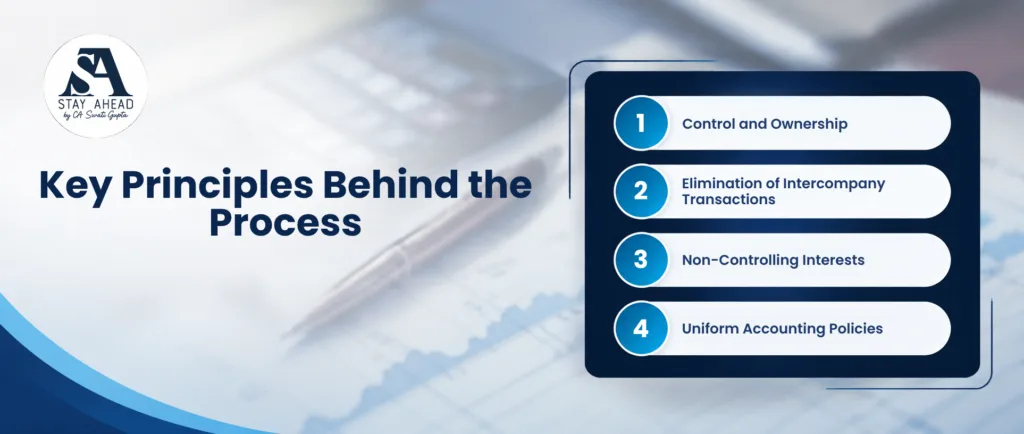
Before you can prepare consolidated financial statements correctly, it helps to understand the principles the whole process is built on.
Control and Ownership
Consolidation is triggered by control, not just ownership percentage. A parent is usually presumed to control a subsidiary when it holds more than 50% of voting rights, but control can exist with a smaller stake through board appointment rights or similar arrangements.
Elimination of Intercompany Transactions
Transactions between group companies — intercompany sales, loans, dividends, and unrealized profit on inventory — are eliminated. Skip this step and group revenue and profit would be inflated by money simply moving from one pocket to another.
Non-Controlling Interests
When a parent owns less than 100% of a subsidiary, the portion it doesn’t own is shown separately as non-controlling interest (NCI), so the statements fairly represent what belongs to the parent’s own shareholders.
Uniform Accounting Policies
All entities included must use consistent accounting policies for similar transactions. If a subsidiary uses a different depreciation method than the parent, adjustments are made before consolidation so figures stay genuinely comparable.
Methods Used in Preparing Consolidated Financial Statements
Not every investment is treated the same way — the method depends on how much influence or control the investor actually has.
Full consolidation is used when the parent has control, typically more than 50% ownership. Here, 100% of the subsidiary’s assets, liabilities, revenues, and expenses are combined line by line with the parent’s, and non-controlling interest is shown separately. This is the method most people mean by consolidated financial statements.
The equity method applies when the investor has significant influence but not control — usually a 20% to 50% stake. The investment is recorded at cost and adjusted each period for the investor’s share of profits or losses, rather than combining line items.
Proportionate consolidation is occasionally used for joint arrangements, where the investor includes only its proportionate share of the joint venture’s figures. It’s less common under current standards but still appears in some jurisdictions.
How to Prepare Consolidation of Financial Statements With Examples
Here’s a simplified walk-through of how to prepare consolidation of financial statements with examples, the way it’s usually taught in practice.
- Gather the standalone financials of the parent and each subsidiary for the same reporting period.
- Add the line items together — combine assets, liabilities, income, and expenses on a line-by-line basis.
- Eliminate intercompany balances, including intercompany sales, loans, and any unrealized profit sitting in closing inventory.
- Calculate non-controlling interest — work out the portion of the subsidiary’s net assets and profit belonging to outside shareholders and show it separately.
- Adjust for fair value and goodwill, recording any difference between the purchase price and the subsidiary’s net identifiable assets.
A simple example: Parent Co. owns 80% of Subsidiary Co. Parent Co. reports revenue of ₹10 crore and Subsidiary Co. reports ₹4 crore, of which ₹1 crore was sold to Parent Co. itself. The group’s statements would show combined revenue of ₹13 crore (₹10 crore + ₹4 crore − ₹1 crore intercompany sale), and 20% of Subsidiary Co.’s net profit would be carved out separately as non-controlling interest rather than added entirely to the parent’s profit.
This kind of worked example is exactly why learners prefer practice over theory — seeing how to prepare consolidation of financial statements with examples makes the elimination entries and NCI calculations click in a way definitions never quite do.
Common Challenges in the Consolidation Process
Even experienced accountants run into trouble here, usually around a handful of recurring issues: subsidiaries using different accounting periods or currencies, incomplete intercompany reconciliations, and goodwill impairment testing pushed to the last minute. Building real fluency with the standards that govern consolidation — rather than relying on rules of thumb — is usually what separates accountants who handle year-end close confidently from those who dread it.
Can QuickBooks Do Consolidated Financial Statements?
This is one of the most common questions we get from business owners. The short answer: QuickBooks can support this process, but with real limitations depending on the version.
QuickBooks Online doesn’t offer native multi-entity consolidation in its standard plans — you typically need QuickBooks Online Advanced, paired with a consolidation feature or third-party app, to combine multiple company files automatically. QuickBooks Desktop Enterprise does include a built-in “combine reports from multiple companies” feature, but it generally can’t automatically eliminate intercompany transactions, handle non-controlling interests, or apply different consolidation methods the way dedicated software or a trained accountant would.
In practice, most businesses with straightforward group structures can use QuickBooks as a starting point, but still need manual adjustments — or a qualified professional — to produce statements that are genuinely compliant with accounting standards.
How Accounting Standards Shape the Consolidation Process
This process isn’t prepared in a vacuum — it follows specific rules under frameworks like Ind AS 110 or IFRS 10, which define control and set out how non-controlling interests and goodwill should be measured and disclosed. Revenue recognized incorrectly at the subsidiary level almost always creates downstream errors once everything is combined, which is one more reason the two topics are usually taught together.
Why Choose CA Swati Gupta
Learning the theory behind consolidated financial statements is one thing — applying it confidently to real group structures and messy intercompany ledgers is another. That’s where caswatigupta comes in. With focused, practitioner-led training in IFRS, Ind AS, and the Diploma in IFRS, caswatigupta helps students and working professionals move past textbook definitions and get comfortable actually preparing these statements the way they’re expected to in real audits and real finance teams. If you’ve been putting off mastering consolidation, this is the moment to start learning it properly with caswatigupta.
Frequently Asked Questions
1. What are consolidated financial statements?
They are combined financial reports that present a parent company and its subsidiaries as a single economic entity, after eliminating intercompany transactions and separately showing any non-controlling interest.
2. How to prepare consolidation of financial statements with examples?
Gather the standalone financials of the parent and subsidiaries, combine line items, eliminate intercompany transactions, calculate non-controlling interest, and adjust for goodwill — as shown in the worked example above.
3. Can QuickBooks do consolidated financial statements?
QuickBooks can assist, especially through QuickBooks Online Advanced or Desktop Enterprise’s multi-company reporting, but it usually needs manual adjustments or professional review to be fully standards-compliant.
4. Who is required to prepare consolidated financial statements?
Generally, any parent company that controls one or more subsidiaries and falls under applicable accounting or listing regulations, though exemptions exist for smaller or wholly-owned intermediate holding companies.
5. What’s the difference between consolidated and standalone financial statements?
Standalone statements report a single legal entity’s results on their own, while the consolidated version combines the parent and all its subsidiaries into one set of figures, net of intercompany transactions.