
If you’ve ever wondered what separates a good quality professional from one who truly understands how organizations stay compliant, efficient, and audit-ready, the answer often comes down to one thing — a Certified Quality Auditor certification. It’s one of those credentials that quietly opens doors, not because it’s flashy, but because it proves you actually know how to evaluate systems, catch gaps before they become problems, and speak the language that regulators and management both trust.
A lot of professionals ask whether this certification is worth the time and effort it takes to earn. It’s a fair question, especially when there are dozens of certifications floating around with overlapping promises. But once you understand what the role actually involves, and what doors it opens, the value becomes a lot clearer.
This guide walks through what a Certified Quality Auditor does, why the certification matters, what it takes to qualify, and where it can take your career. Along the way, if you’re someone who works closely with financial processes, you’ll notice there’s real overlap with disciplines like a financial reporting course online, since audit thinking and financial discipline often go hand in hand.
What Does a Certified Quality Auditor Do?
At its core, a Certified Quality Auditor is responsible for examining an organization’s quality systems and processes to confirm they meet internal standards, industry regulations, and customer expectations. This isn’t just about ticking boxes on a checklist. It involves understanding how a business operates end to end, identifying where things could go wrong, and recommending fixes before small issues snowball into bigger ones.
People in this role review documentation, interview staff, observe processes on the floor, and compare what’s actually happening against what’s supposed to happen according to written procedures. It’s detail-oriented work, but it also demands a broader view of how systems connect — something that becomes second nature once you’ve earned your Certified Quality Auditor certification.
Auditors often work across industries — manufacturing, healthcare, pharmaceuticals, food safety, and increasingly, financial services. That cross-industry relevance is part of why professionals who’ve completed a financial statements course sometimes find quality auditing to be a natural next step, since both fields reward precision and an eye for inconsistency.
Why Pursue Certified Quality Auditor Certification?
There’s a reason this credential, offered through ASQ (American Society for Quality), has stayed relevant for decades. It signals to employers that you’re not just familiar with quality concepts in theory — you can apply them in real audit situations.
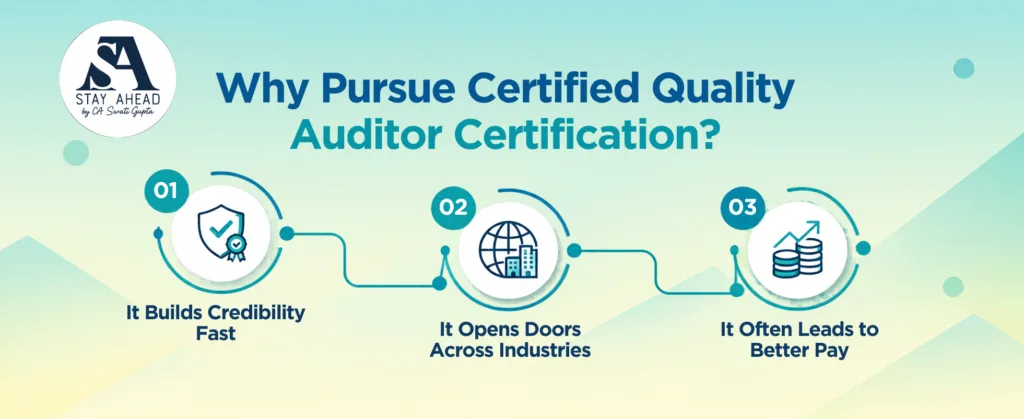
It Builds Credibility Fast
When your resume shows a Certified Quality Auditor certification, hiring managers don’t need convincing that you understand audit methodology, risk assessment, or corrective action processes. The certification does that talking for you.
It Opens Doors Across Industries
Because quality auditing principles are largely universal, this certification travels well. Someone certified in a pharmaceutical setting can often transition into automotive or aerospace quality roles without starting from scratch.
It Often Leads to Better Pay
Certified professionals typically command higher salaries than their uncertified peers in similar roles, simply because organizations are willing to pay for proven, tested expertise rather than take a chance on unverified skills.
ASQ Quality Certification: Eligibility and Requirements
Before you can sit for the exam, it helps to understand what ASQ expects. The ASQ quality certification process isn’t overly complicated, but it does require some planning.
Certified Auditor Requirements
Generally, candidates need a combination of education and professional experience in quality auditing or a related field. ASQ typically requires several years of work experience, with at least part of that time spent in a role with audit-related responsibilities. A relevant degree can sometimes reduce the required years of experience, so it’s worth checking the latest eligibility matrix before applying.
Exam Structure
The Certified Quality Auditor exam covers areas like audit fundamentals, audit process, auditor competencies, resource management, quality tools and techniques, and corrective and preventive action. It’s a multiple-choice format, and candidates are tested on both conceptual knowledge and practical application — not just memorized definitions.
Skills You Need to Succeed as a Certified Quality Auditor
Passing the exam is one milestone, but thriving in the role requires a specific skill set that goes beyond textbook knowledge.
- Analytical thinking — the ability to spot patterns and inconsistencies in data, documentation, and processes.
- Communication — auditors need to explain findings clearly, often to people who weren’t expecting bad news.
- Attention to detail — small discrepancies can point to larger systemic issues.
- Ethical judgment — auditors must remain objective even under pressure from management or stakeholders.
- Process knowledge — a working understanding of quality management systems like ISO 9001.
Interestingly, many of these same skills are valued in financial and regulatory work, which is why understanding financial reporting standards can genuinely complement your audit toolkit if your career touches both compliance and finance.
Career Opportunities After Certified Quality Auditor Certification
Once certified, the career paths tend to branch in a few directions. Some professionals move into internal audit roles within a single organization, becoming the go-to person for quality compliance. Others become independent or third-party auditors, working across multiple companies and industries, which often pays well given the specialized trust involved.
There’s also a growing path into quality management leadership — many Quality Managers and Directors started their careers as auditors because the role gives you an unusually complete picture of how a business actually functions, not just how it’s supposed to function on paper.
For professionals already working in finance-adjacent roles, pairing audit expertise with a solid grounding in IFRS 15 Revenue Recognition can be a smart combination, particularly for companies where quality processes intersect with financial controls and reporting accuracy.
How to Prepare for the Certified Quality Auditor Exam
Preparation matters as much as experience. Most successful candidates combine ASQ’s official body of knowledge with practice exams, study groups, and real-world case studies. It’s also worth reviewing ISO standards closely, since a large portion of the exam draws from how quality systems are structured and audited in practice.
Give yourself enough lead time — rushing the preparation for a Certified Quality Auditor certification tends to backfire, especially given how application-based the questions can be.
Why Choose CA Swati Gupta
Earning a Certified Quality Auditor certification is a meaningful step, but pairing it with strong financial and reporting knowledge can set you apart even further — and that’s exactly where caswatigupta comes in. With structured, practical training in IFRS, Ind AS, and financial reporting, caswatigupta helps professionals build the kind of well-rounded expertise that today’s employers are actively looking for. Whether you’re an auditor wanting to understand financial statements more deeply, or a finance professional exploring quality systems, caswatigupta’s courses are designed to bridge that gap with clarity and real-world relevance — not just theory.
If you’re serious about standing out in a competitive job market, combining your Certified Quality Auditor certification with the right financial training through caswatigupta could be exactly the career move you’ve been looking for.
FAQs
1. How long does it take to earn a Certified Quality Auditor certification?
It varies, but most candidates spend a few months preparing after they’ve met the eligibility requirements, depending on their existing audit experience.
2. Is work experience mandatory for ASQ quality certification?
Yes, ASQ generally requires a set number of years in quality-related roles, though a relevant degree can sometimes offset part of that requirement.
3. What industries hire Certified Quality Auditors?
Manufacturing, healthcare, pharmaceuticals, automotive, aerospace, and increasingly financial services all rely on certified auditors.
4. Does the certification expire?
Yes, ASQ certifications typically require recertification every few years through continuing education or exam renewal.
5. Can a Certified Quality Auditor certification help in a finance career?
Absolutely. Many finance professionals find that audit skills pair well with financial reporting and compliance work, making the credential valuable even outside traditional quality roles.