

Scroll through any accounting forum these days and IFRS comes up constantly. Finance professionals who’ve spent years comfortable with Ind AS are suddenly being asked, often with very little warning, to understand and apply international standards at work. That’s really why so many accountants end up searching for a DipIFR course online instead of trying to stitch together knowledge from random YouTube videos and outdated PDFs they found somewhere online.
DipIFR, the Diploma in International Financial Reporting from ACCA, has become one of those qualifications that quietly opens doors. It isn’t a multi-year degree. You won’t spend three years chasing it. But it does carry weight with multinational employers, audit firms, and consulting houses, and that matters more than people realise until they’re job hunting. The tricky part is that clearing it isn’t automatic just because you enrol somewhere. You need proper structure behind your prep, and a solid financial reporting course online is usually what separates candidates who pass comfortably from those who scrape through, or don’t.
This piece walks through what a DipIFR course online actually involves, who should even bother with it, how to judge an IFRS certification course before paying for one, and what makes an IFRS online course genuinely worth your time instead of just another inbox full of PDFs.
What Is the DipIFR Qualification, Really?
Before you sign up for any DipIFR course online, it’s worth knowing exactly what you’re getting into. DipIFR is ACCA’s globally recognised diploma that checks whether you can actually apply International Financial Reporting Standards to real-world business situations, not just recite them. There’s no theory-only exam here where you memorise definitions and hope for partial credit. Instead, you get case-study questions built around consolidations, financial instruments, revenue recognition, impairment, and group accounting.
The exam runs once every six months, in June and December, and it’s a single three-hour paper. Pass mark: 50 percent. Sounds manageable on paper. Ask anyone who’s sat it without proper preparation, though, and they’ll tell you the real challenge isn’t recalling the standards, it’s applying them under time pressure.
Who Should Consider a DipIFR Course Online
This qualification isn’t really aimed at people just starting their accounting careers. It’s built for professionals who already have some grounding and want to go deeper. That usually means:
- Chartered Accountants working in Ind AS who need IFRS exposure for global-facing roles
- Finance managers at multinationals where group reporting runs on IFRS
- Auditors who deal with IFRS-based financial statements regularly
- ACCA affiliates rounding off their existing qualification
- Professionals eyeing roles in the Middle East, UK, or other IFRS-heavy markets
If any of that sounds like you, the investment tends to pay off fairly fast, both in day-to-day confidence and on your resume.
Why a Structured Financial Reporting Course Online Actually Matters
You could try clearing DipIFR by reading the standards on your own. People attempt it every year. But most working professionals simply don’t have unlimited study hours lying around, and IFRS standards are dense enough that self-study alone tends to leave gaps you won’t notice until you’re staring at the exam paper.
A decent financial reporting course online helps in a few specific ways.
For one, it sequences the syllabus sensibly instead of leaving you to jump between standards at random. You start with the conceptual framework and work your way toward heavier topics like business combinations and group accounts, so nothing feels disconnected.
It also gives you practice that’s actually shaped like the exam. DipIFR questions are scenario-driven, and how you present your answer counts almost as much as knowing the standard cold. Mock exams and marked practice questions teach you what examiners are genuinely looking for, which is hard to guess on your own.
And frankly, it keeps you accountable. Live sessions, deadlines, doubt-clearing calls, they create a rhythm that’s tough to build when you’re studying alone after a nine-hour workday and just want to sleep.
How to Evaluate an IFRS Certification Course Before Enrolling ?
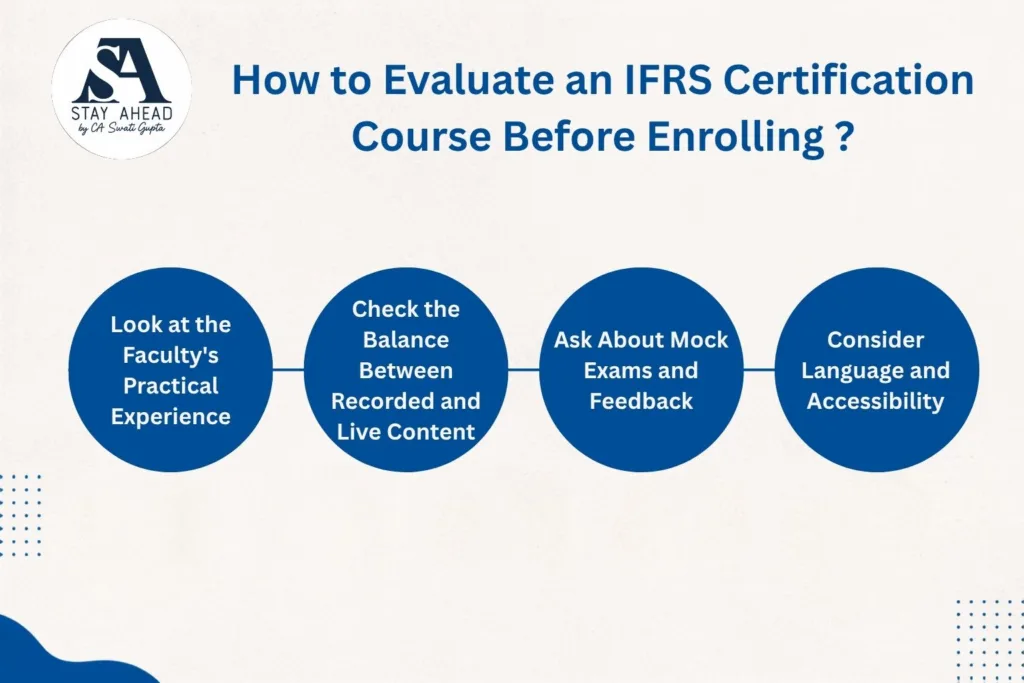
Not every course calling itself an IFRS certification course is built with the same care. A few things worth checking before you hand over your money.
Look at the Faculty’s Practical Experience
IFRS is applied knowledge, not textbook trivia. A tutor who’s actually worked on consolidations or handled IFRS transitions explains things differently than someone reading off slides. Ask about the trainer’s background upfront, and watch a sample class if one’s available.
Check the Balance Between Recorded and Live Content
Fully pre-recorded courses give you flexibility but no room to ask questions in real time. Fully live courses build discipline but can clash badly with work schedules. The better IFRS online course setups blend both, recorded lectures you can rewatch, plus live sessions for clearing doubts.
Ask About Mock Exams and Feedback
This might be the single biggest differentiator, honestly. A course offering two or three mock exams with actual written feedback from a tutor beats one that just dumps a question bank on you and disappears.
Consider Language and Accessibility
For a lot of Indian and South Asian professionals, learning dense standards in a mix of Hindi and English makes the concepts land faster than pure academic English would. If a provider offers that flexibility, it’s worth weighing seriously, especially if IFRS terminology still feels foreign to you.
What a Well-Designed DipIFR Course Online Should Cover
Whichever provider you go with, make sure the syllabus actually includes these areas, since they show up consistently in the exam:
- Conceptual Framework and Presentation of Financial Statements – everything else is built on this
- Revenue Recognition (IFRS 15) – a recurring favourite for scenario questions
- Financial Instruments (IFRS 9) – widely considered the toughest section
- Leases (IFRS 16) – often tested through practical journal entries
- Business Combinations and Consolidations (IFRS 3, IFRS 10) – usually carries the most marks
- Impairment of Assets (IAS 36) and Provisions (IAS 37) – smaller weightage but examined reliably
If a course rushes through consolidations or spends too much time on minor standards, take that as a warning sign.
Common Mistakes Candidates Make While Preparing
Even with a genuinely good IFRS certification course behind them, candidates trip up in predictable ways.
Some treat DipIFR like a memory test, when it really rewards application. Reciting a standard word-for-word without applying it to the scenario given rarely earns marks.
Others ignore time management until it’s too late. The three-hour format punishes anyone who lingers too long on one question, so practising under timed conditions during your course isn’t optional, it’s essential.
A lot of candidates also push group accounting to the last month, thinking they’ll manage. Consolidation carries serious weightage, and cramming it that late usually backfires badly.
And then there’s skipping mock exams altogether. Some people finish every lecture but never sit a full mock, assuming they’ll figure it out on the day. This is probably the single most common reason people narrowly miss passing.
A dependable DipIFR course online should actively push you away from these habits, not just hand you content and hope for the best.
How Long Does It Realistically Take to Prepare?
Most candidates with some accounting background need roughly three to four months of steady study, putting in five to seven hours a week around a full-time job. If IFRS is genuinely new territory for you, stretching that to five months with a lighter weekly load usually works better than trying to compress it.
Consistency matters more than total hours logged. Two hours spread across four days a week beats one exhausting eight-hour weekend session, particularly for a subject where each concept builds on the last one.
Why Choose CA Swati Gupta
The provider you choose shapes almost everything about how this preparation feels. CA Swati Gupta has built a DipIFR course online around what working professionals actually need, depth without unnecessary complication. The teaching leans on real financial statement scenarios rather than abstract theory, which lines up with exactly what the DipIFR exam tests.
Practical, Application-First Teaching
Every standard comes with worked examples pulled from real reporting situations, so you’re not just memorising definitions, you’re seeing how each concept actually plays out on a balance sheet or a consolidated statement.
Flexible Learning in Hindi and English
Being able to move between Hindi and English while learning technical IFRS terminology removes a barrier that purely English-medium courses often create. This bilingual approach is one of the things that makes CA Swati Gupta’s teaching click for a lot of students who otherwise struggle with the jargon.
Mock Exams With Personal Feedback
Instead of a generic question bank, students get mock exams reviewed one-on-one, so you know exactly where your answers fall short well before the actual exam tells you the hard way.
A Track Record Candidates Trust
Feedback from past students keeps pointing to the same things: clear explanations and genuine approachability during doubt-clearing sessions, which is often what keeps candidates committed all the way through to exam day.
If you’re weighing options for a financial reporting course online, an IFRS certification course, or just a dependable IFRS online course, CA Swati Gupta’s DipIFR programme is worth a serious look, especially if you’d rather have structured guidance than figure everything out solo. Choosing caswatigupta essentially means choosing a course shaped around how working professionals actually learn, not a generic template repackaged for everyone.
Conclusion
Picking the right DipIFR course online isn’t really about ticking a box on your resume. It’s about actually understanding how international financial reporting works, well enough to apply it confidently, whether that’s a group consolidation at your desk or a client engagement involving cross-border reporting. A good IFRS online course shouldn’t feel like sitting through a lecture series. It should feel like a guided path toward exam readiness, backed by real examples and honest feedback on where you actually stand, not just where you think you stand.
If you’re serious about clearing DipIFR without burning months on trial and error, take the time to compare your options properly. Pay attention to teaching quality, mock exam support, and flexibility, because those three things matter more than glossy marketing ever will. CA Swati Gupta’s programme brings all three together, which makes it a strong choice for anyone ready to actually commit to this qualification. Why choose caswatigupta? Because the course is built by someone who understands both the exam and the professionals sitting it, and that combination is usually what separates preparing from actually passing.
Frequently Asked Questions
1. Is a DipIFR course online enough to clear the exam, or do I need additional self-study?
A structured course covers the syllabus and gives you exam technique, but some independent revision is still expected. Most candidates supplement course material with two to three hours of personal practice each week.
2. How is DipIFR different from ACCA’s full qualification?
DipIFR is a standalone diploma focused entirely on IFRS application, while the full ACCA qualification covers a much broader range of subjects including tax, audit, and management accounting. DipIFR can be completed in months rather than years.
3. Do I need ACCA membership to enrol in DipIFR?
No. DipIFR is open to qualified accountants, including Chartered Accountants, as well as those with relevant accounting experience, even without prior ACCA registration.
4. What if I fail the exam after completing a course?
Many providers, including well-structured IFRS certification course programmes, allow you to retake the training component at a reduced fee or attend refresher sessions before your next attempt. Always confirm this policy before enrolling.
5. Can working professionals realistically manage a DipIFR online course alongside a full-time job?
Yes, and in fact most candidates are working professionals. The key is choosing a course with recorded lecture access, so you can revisit sessions around your schedule rather than missing content due to work commitments.