
If you’ve spent any time around a finance team in India, chances are you’ve heard someone use IFRS and Ind AS as if they mean the same thing. They don’t, and the gap between them is bigger than most people assume. Whether you’re preparing financial statements, auditing a multinational client, or trying to move ahead in your accounting career, getting this comparison of IFRS and Ind AS right can save you from mistakes that get expensive fast.
I run into this mix-up all the time while teaching a financial reporting course online. A student will assume that since Ind AS is “based on” IFRS, a lease or a financial instrument gets treated exactly the same way under both. Then the numbers refuse to tie out, the auditor flags it, and everyone loses an afternoon tracing where the gap crept in. More often than not, it turns out to be one of a handful of differences that keep showing up, year after year, client after client.
So let’s actually get into it — no jargon overload, just the parts of this comparison that matter once you’re sitting with a real set of financial statements in front of you.
What Is IFRS?
IFRS stands for International Financial Reporting Standards, issued by the International Accounting Standards Board, or IASB, and used in some form across more than 140 countries. The whole point of it was to give investors, lenders, and regulators a common accounting language, so a set of accounts prepared in Frankfurt could be reasonably compared against one prepared in Singapore. Companies raising money abroad, listing on foreign exchanges, or running subsidiaries overseas tend to gravitate toward IFRS simply because it’s the standard most global investors already trust.
Anyone aiming for roles that touch global reporting will usually save themselves a lot of trial and error by building this base through a structured IFRS certification course instead of piecing it together from scattered PDFs and old exam notes.
What Is Ind AS?
Ind AS, or Indian Accounting Standards, is India’s own take on IFRS — notified by the Ministry of Corporate Affairs with input from the ICAI. Converged with IFRS, not a copy of it. The broad structure looks familiar, but plenty of provisions have been reworked or carved out entirely to fit Indian regulatory, legal, and tax realities. It applies to specified classes of companies based on net worth and listing status, rolled out in phases rather than all in one go.
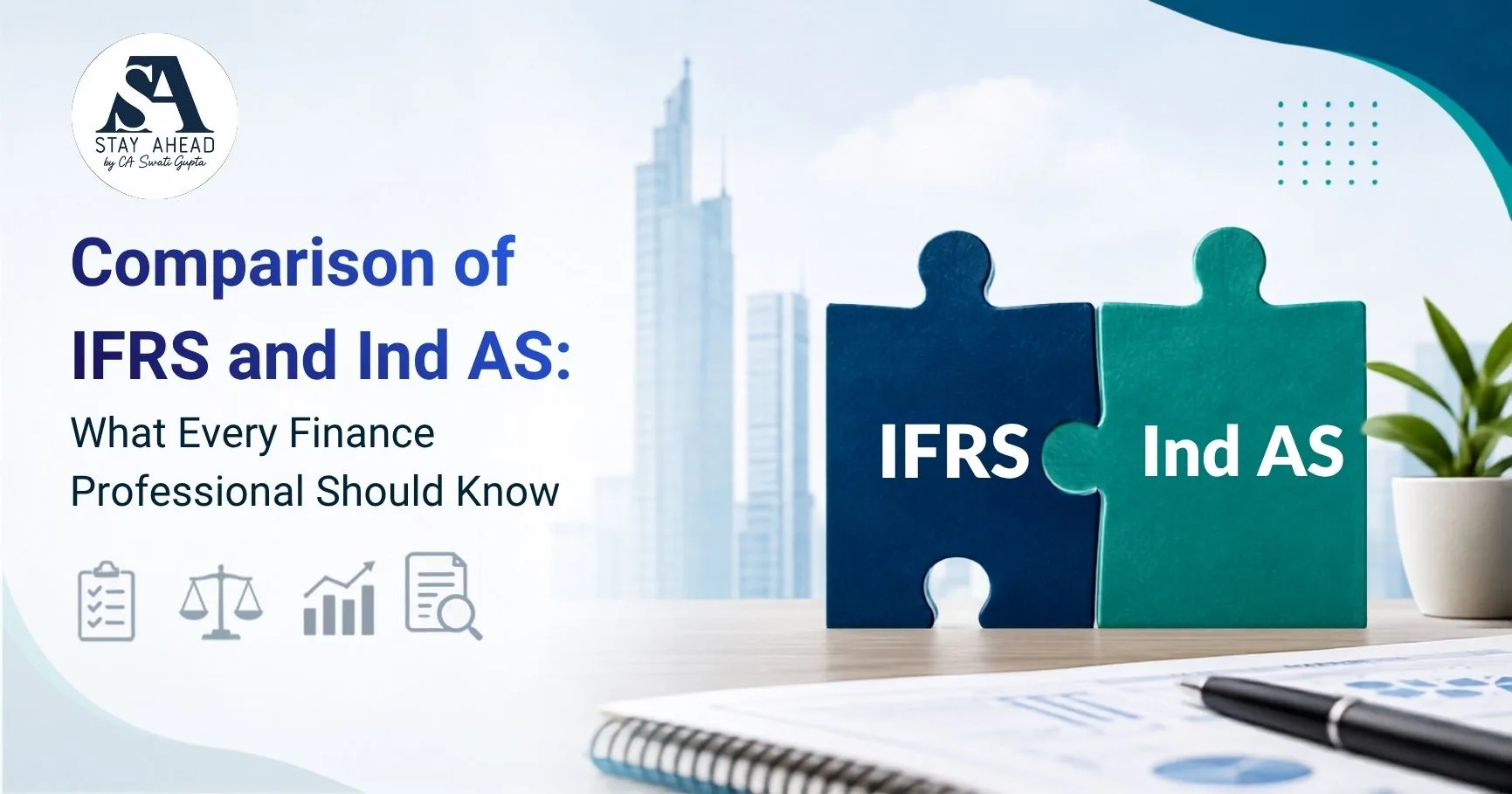
And that, really, is the crux of any comparison of IFRS and Ind AS: one is a global standard, the other is India’s version of it, shaped by carve-outs that were added on purpose, not by accident.
Comparison of IFRS and Ind AS: The Core Differences
Origin is a good place to start. IFRS comes from the IASB, an independent body based in London. Ind AS gets notified by India’s MCA, drawing heavily on IFRS text but filtered through India’s own standard-setting process before it becomes law here. On paper the two look alike; in practice, the authority behind each is different, and that affects how fast updates actually reach Indian companies.
First-time adoption is another spot worth flagging. IFRS 1 covers how a company moves from its previous GAAP over to IFRS. Ind AS 101 does something similar but throws in India-specific exemptions — property, plant and equipment carrying values, for one, or certain business combination treatments carried forward from the old Indian GAAP regime.
Presentation of financial statements diverges more than people expect. IAS 1 gives companies fairly wide latitude in how they lay out a balance sheet or income statement. Ind AS 1 is tighter, tied closely to Schedule III of the Companies Act, 2013, so an Indian company doesn’t get quite the same free hand a pure-IFRS filer would.
Revenue recognition, on the other hand, is where the two frameworks barely differ at all. IFRS 15 and Ind AS 115 both run on the same five-step model, and honestly, this is one part of the comparison of IFRS and Ind AS where you’ll find very little daylight between them — a decent example of how far convergence has actually come.
Financial instruments sit in similar territory. IFRS 9 and Ind AS 109 line up closely on classification and measurement, though small gaps remain around compound financial instruments and a few transition provisions — enough, in some cases, to shift reported equity in the year a company first adopts the standard.
Leases followed a similar path. IFRS 16 and Ind AS 116 both pushed lessees toward putting nearly every lease on the balance sheet. The mechanics match up in most cases, though practical expedients and disclosure requirements occasionally pull apart, particularly for short-term or low-value leases.
Business combinations are where this comparison actually moves the needle on consolidated numbers. Ind AS 103 allows exemptions for common-control transactions — mergers within the same corporate group — that pure IFRS 3 doesn’t extend the same way. One difference like that can change how goodwill or capital reserve gets booked, and not by a small amount either.
Functional and presentation currency is a smaller point but worth knowing. IFRS leaves companies free to pick a functional currency based on their primary economic environment. Ind AS follows roughly the same principle, though Indian statutory filing rules sometimes bolt on extra constraints.
Terminology matters too, in a quieter way. Plenty of Ind AS standards still carry references to Indian legal terms — the Companies Act, for instance — that simply don’t show up anywhere in the global IFRS text. It sounds trivial until you’re reading disclosures across two jurisdictions and realise the wording itself is telling you something.
Why This Comparison Actually Matters for Your Career
None of this stays purely academic once you’re working. Statutory auditors need to know which framework a client falls under and exactly where the local carve-outs kick in. Anyone handling financial reporting for an MNC ends up reconciling the parent company’s IFRS numbers against a subsidiary’s Ind AS filings, often by hand, more often than anyone would like. In equity research or investment banking, missing a treatment difference between IFRS and Ind AS can quietly throw off an entire valuation model without anyone noticing until much later. And for CA, CMA, or CS students, this comparison keeps resurfacing — not just in exam papers, but in the client work that follows once you’ve actually qualified.
Recruiters have gotten pickier here too. They’re not just after someone who can define IFRS and Ind AS on a whiteboard anymore. They want someone who can look at a set of accounts and point to exactly where the two frameworks would land differently.
Where Self-Study Usually Falls Short
Reading about the comparison of IFRS and Ind AS only gets you partway there. It’s applying it to an actual set of financial statements — messy real numbers, footnotes, transition disclosures and all — where it finally sticks. That gap is why a lot of learners eventually move on from textbooks toward something more structured: working through case studies and disclosure examples instead of just memorising standard numbers in isolation.
If you’d rather pace this around a job or an articleship schedule, an IFRS online course lets you go back over the trickier bits — lease accounting, financial instruments, whatever isn’t clicking yet — as many times as it actually takes.
Common Mistakes People Make in This Comparison
A few patterns come up again and again, almost predictably so. People assume Ind AS is a word-for-word copy of IFRS, when the entire point of it is the carve-outs, not the resemblance. They skip past Schedule III presentation rules while applying Ind AS, forgetting IFRS has no direct equivalent mandate. They gloss over transition adjustments during first-time adoption, which can quietly shift opening retained earnings more than expected. And some treat either framework as fixed, when the IASB and the ICAI both issue amendments regularly enough that what held true two years ago might already be outdated.
Most of these trace back to not enough hands-on time with real financial statements, rather than any real gap in theory.
Why Choose CASwatiGupta
Learning the comparison of IFRS and Ind AS from a textbook is one thing. Learning it from someone who has actually sat through audits, consolidations, and reporting transitions under both frameworks is a different experience altogether, and that’s the gap CASwatiGupta is built to close. Courses here are shaped around how these standards actually get applied inside real Indian companies and multinational subsidiaries, not just how they read on paper.
Whether you’re a working professional trying to plug one specific gap, a CA/CMA/CS aspirant getting ready for exams, or someone eyeing a global reporting role down the line, the focus stays on understanding that holds up when a client asks a follow-up question — not just understanding that survives a quiz. If mastering the comparison of IFRS and Ind AS is genuinely on your list this year, CASwatiGupta is built around exactly that kind of grounded, practical training.
FAQs
1. Is Ind AS exactly the same as IFRS?
Not quite. Ind AS is converged with IFRS but carries India-specific carve-outs and modifications, especially around business combinations, presentation formats, and first-time adoption exemptions.
2. Which companies in India actually have to follow Ind AS?
It comes down to criteria like net worth and listing status, phased in by the MCA over several years. Companies below those thresholds can still follow existing Indian GAAP.
3. Do I really need to learn both IFRS and Ind AS separately?
If you’re working with multinational clients or aiming for global reporting roles, yes. Understanding both frameworks — and knowing exactly where they diverge — isn’t optional at that point.
4. Which one carries more weight for CA or CMA exams?
Both show up, but Ind AS tends to matter more in company-law and audit-heavy papers, while IFRS knowledge helps more with global reporting and consolidation topics.