
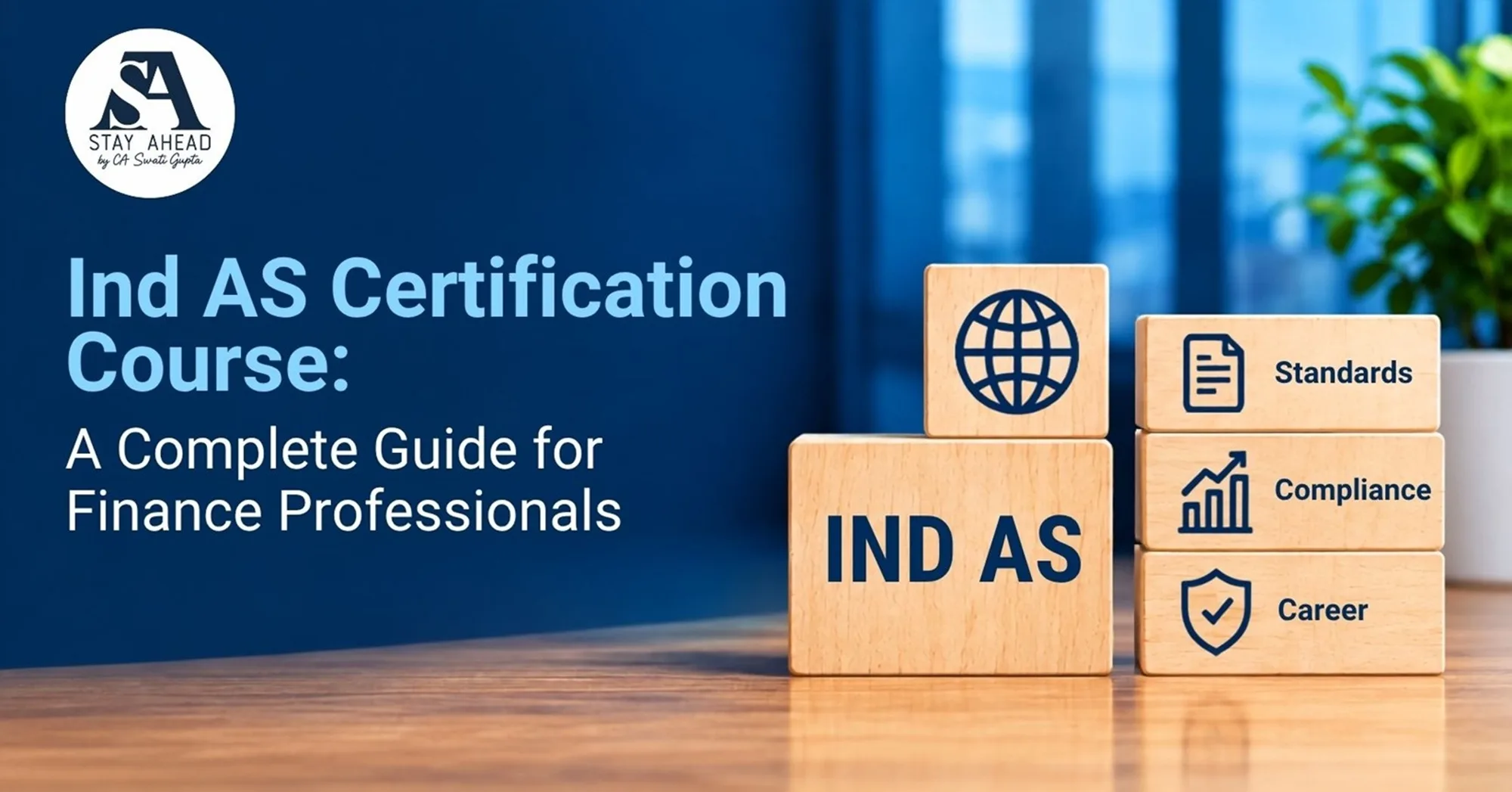
If you’ve spent any time around India’s accounting and finance circles lately, you’ve probably noticed Ind AS coming up more often than it used to. Companies are hiring for it, interviewers are asking about it, and finance teams are scrambling to stay compliant as more entities fall under its scope every year. That’s exactly why so many professionals are now searching for a good ind as certification course to get ahead of the curve.
Whether you’re a practicing CA, a CS, an MBA finance graduate, or someone working in a corporate finance role, understanding Ind AS isn’t optional anymore — it’s fast becoming a baseline expectation. This guide walks you through what an ind as certification course actually teaches, who it’s meant for, and how to pick one that’s genuinely worth your time and money.
What Is an Ind AS Certification Course?
An ind as certification course is a structured training program that teaches you how to apply the Indian Accounting Standards (Ind AS) — the framework Indian companies use to prepare their financial statements in line with global reporting practices. These standards are largely converged with IFRS, so once you understand Ind AS well, you’re also building a strong base in international accounting concepts.
Unlike traditional classroom accounting education, which tends to stay theoretical, a good ind as certification course focuses heavily on real company financials, disclosures, and the kind of judgment calls accountants actually make on the job — not just definitions copied from the standard.
Who Should Enroll in This Course
- Practicing Chartered Accountants who want to specialise in corporate reporting
- Finance and accounts professionals working with listed or large private companies
- CA, CS, and CMA students preparing for their professional exams
- Working professionals looking to move into financial reporting, audit, or consolidation roles
Why Ind AS Knowledge Has Become So Important
Since 2016, Ind AS has been mandatory for a growing number of Indian companies, based on their net worth and listing status. Every year, more entities fall under this bracket, and with them comes a rising demand for people who actually understand how these standards work in practice, not just in theory.
This is one of the biggest reasons the demand for an ind as certification course has grown steadily over the past few years. Recruiters aren’t just looking for candidates who’ve heard of Ind AS — they want people who can walk into a finance team and start applying it from day one, without months of hand-holding.
What You’ll Actually Learn
Core Standards Covered
A well-designed ind as certification course usually walks you through the standards that come up most often in real audits and financial statement preparation, including:
- Revenue recognition (Ind AS 115)
- Financial instruments (Ind AS 109)
- Leases (Ind AS 116)
- Business combinations (Ind AS 103)
- Consolidated financial statements (Ind AS 110)
- Property, plant and equipment (Ind AS 16)
Practical Application and Case Studies
Reading a standard is one thing; applying it to a messy, real-world set of transactions is another. That’s why most quality programs pair each topic with worked examples — think lease classification for a manufacturing company, or how a business combination is accounted for when a company acquires a subsidiary mid-year. This practical layer is what really separates a strong course from simply reading the bare text of a standard.
Ind AS vs IFRS: Where Understanding One Helps With the Other
Since Ind AS is based on IFRS with a few carve-outs for the Indian context, most learners eventually want to know how the two frameworks differ. A detailed comparison of IFRS and Ind AS is genuinely useful here, because it helps you spot exactly where Indian standards diverge — for instance, in areas like revaluation of fixed assets or certain financial instrument classifications. Understanding these differences early on makes it much easier to work with multinational clients or global reporting teams later in your career.
Career Benefits of Completing the Course
Here’s the honest picture: an ind as certification course won’t hand you a job on its own, but it does make you noticeably more employable in a few specific ways.
- You become relevant for corporate reporting, audit, and consolidation roles at listed companies
- You can speak confidently in interviews about disclosures, standard applications, and transition adjustments
- You build a foundation that supports later specialisation in IFRS reporting, XBRL, or financial due diligence
- You add a credential that recruiters recognise, especially when it comes from a practicing CA rather than a generic training portal
Many professionals also treat this as a stepping stone before enrolling in a full financial statements course, since Ind AS forms such a large part of how modern financial statements are actually put together.
How to Choose the Right Course
Not all programs are created equal, and with so many options available online now, it’s worth being a little selective.
What to Check Before You Enroll
- Is the faculty a practicing professional with real audit or reporting experience, not just an academic?
- Does the course include recent amendments and current disclosure requirements?
- Are there practical exercises, case studies, or mock financial statements to work through?
- Is there support for doubt-solving, or is it just recorded lectures with no interaction?
- Does it also build a foundation for IFRS concepts, useful if you eventually decide to study global standards in more depth?
A rushed, purely theoretical ind as certification course might get you a certificate, but it won’t necessarily prepare you for the scenarios you’ll actually face at work.
Who Typically Teaches These Courses
The best ind as certification course programs are usually led by practicing Chartered Accountants who deal with these standards regularly — not just in classrooms, but in actual audits and financial statement preparation. That real-world exposure tends to show up in how they explain tricky areas like impairment testing, deferred tax under Ind AS, or first-time adoption adjustments.
Why Choose CASWATIGUPTA
If you’re serious about building genuine expertise rather than just collecting a certificate, the ind as certification course at CASWATIGUPTA is built around exactly that idea. The course is designed and taught by CA Swati Gupta, drawing on real audit and financial reporting experience rather than textbook explanations alone.
Here’s what sets it apart:
- Lessons built around real company financials and disclosures, not just standard text
- Coverage of the latest amendments, so you’re learning what’s actually applicable today
- A structure that also strengthens your understanding of global reporting concepts
- Direct doubt-resolution support instead of one-way recorded content
- A learning path that fits naturally alongside CASWATIGUPTA’s other programs, including a dedicated ifrs certification course for those who want to go further
Choosing where to learn Ind AS matters more than most people realise. This course is built to make sure you don’t just clear an exam — you walk away actually knowing how to apply the standards on the job. If you’re ready to build that kind of practical expertise, CASWATIGUPTA is a good place to start.
Frequently Asked Questions
1. Who should take this course?
It’s best suited for CAs, CS professionals, finance graduates, and working professionals in accounting or audit roles who need to understand and apply Indian Accounting Standards in their day-to-day work.
2. How long does it typically take to complete?
Most programs run anywhere from a few weeks to a couple of months, depending on how in-depth the coverage is and whether it includes case studies and practical exercises.
3. Is Ind AS the same as IFRS?
Not exactly. Ind AS is based on IFRS but includes certain modifications suited to the Indian regulatory environment, so while the two are closely aligned, they aren’t identical.
4. Do I need to be a Chartered Accountant to enroll?
No. While many CAs take this course to specialise further, it’s equally useful for CS and CMA students, MBA finance graduates, and working professionals who deal with financial reporting.
5. How is this different from a general financial reporting course?
A general course often covers accounting broadly, while this one focuses specifically on Ind AS — the standards, disclosures, and practical application that Indian companies are required to follow.