
If you’ve ever tried to make sense of a parent company’s financial statements alongside those of its subsidiaries, you already know how messy things can get without a proper system in place. That’s exactly where accounting and consolidation comes in. It’s the process that takes several sets of books — often maintained in different currencies, under different local rules — and brings them together into one clear, accurate picture of a group’s financial health.
For many businesses, especially ones that have grown through acquisitions or expanded into new markets, accounting and consolidation isn’t optional. It’s a regulatory requirement, an investor expectation, and honestly, a practical necessity if management wants to understand how the whole group is actually performing rather than just looking at individual entities in isolation.
In this guide, we’ll walk through what accounting and consolidation actually involves, the methods used, the common challenges finance teams run into, and how proper training — like the International Accounting Standards Course — can help you build the skills to handle this confidently. We’ll also look at how technology is reshaping this space and what to consider before choosing a tool to support your consolidation process.
What Does Accounting and Consolidation Actually Mean?
At its core, accounting and consolidation is the process of combining the financial statements of a parent company and its subsidiaries into a single set of financial statements. Instead of reporting on each entity separately, the group presents its financial position, performance, and cash flows as if it were one economic entity.
This matters because stakeholders — investors, lenders, regulators — don’t just want to see how the parent company is doing on its own. They want the full picture. A subsidiary might be carrying significant debt, or a sister company might be generating most of the group’s revenue. Without accounting and consolidation, none of that context would be visible in isolated financial statements.
The process typically involves eliminating intercompany transactions, adjusting for minority interests, aligning accounting policies across entities, and converting foreign currency figures where needed. It sounds straightforward on paper, but in practice, it requires a solid grasp of standards and a fair amount of precision.
Why Accounting and Consolidation Is More Complex Than It Looks
A lot of people assume consolidation is just “adding up the numbers.” It isn’t. Every subsidiary might follow slightly different accounting policies, use different fiscal year-ends, or report in a different functional currency. Before any consolidation accounting method can even be applied, all of this needs to be standardized.
Then there’s the matter of intercompany eliminations. If one subsidiary sells goods to another within the same group, that transaction needs to be removed from the consolidated figures — otherwise, you’d be double-counting revenue and expenses that never actually left the group. Getting this wrong is one of the most common mistakes in accounting and consolidation, and it can quietly distort a company’s reported profitability.
If you’re looking to strengthen your technical foundation here, understanding How to Prepare Consolidated Financial Statements step by step makes a real difference. It’s one thing to know the theory behind accounting and consolidation; it’s another to actually sit down and prepare a consolidated balance sheet correctly, adjustment by adjustment.
Common Consolidation Accounting Methods You Should Know
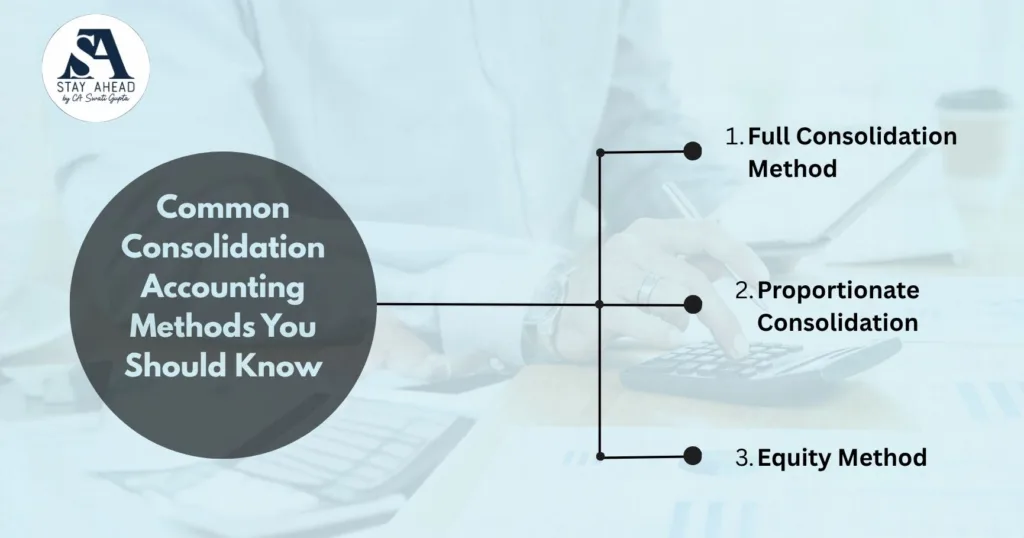
There isn’t just one way to consolidate financial statements — the method used depends largely on the level of control the parent company has over the subsidiary. Broadly, the approaches fall into a few categories.
Full Consolidation Method
This is used when the parent company has control over the subsidiary, typically through majority ownership. Under this approach, 100% of the subsidiary’s assets, liabilities, income, and expenses are included in the consolidated statements, with a separate line for non-controlling interests where applicable. This is the most common consolidation accounting method used in group reporting under accounting and consolidation frameworks worldwide.
Proportionate Consolidation
Used less frequently now under IFRS, this method includes only the parent’s proportionate share of a jointly controlled entity’s assets, liabilities, income, and expenses. It’s more relevant in joint venture arrangements than straightforward parent-subsidiary relationships.
Equity Method
Technically not a form of full accounting and consolidation, the equity method is used when the investor has significant influence but not control — usually a 20–50% stake. The investment is recorded at cost and adjusted for the investor’s share of profits or losses.
Knowing which method applies to which scenario is a skill in itself, and it’s something finance professionals genuinely need to practice, not just memorize.
Why Revenue Recognition Matters in the Consolidation Process
One area that often trips up even experienced accountants is how revenue is recognized across group entities before consolidation happens. If subsidiaries are applying revenue recognition principles inconsistently, the consolidated figures will reflect that inconsistency too.
This is why a solid understanding of Revenue Recognition Accounting is so important before you even get to the consolidation stage. You can’t accurately combine financial statements if the underlying revenue figures weren’t recognized correctly in the first place. Getting this foundation right makes every step of accounting and consolidation that follows much more reliable.
The Role of Technology: Accounting Consolidation Software
As businesses scale and the number of subsidiaries grows, manually consolidating spreadsheets becomes impractical — and risky. This is where accounting consolidation software steps in, automating much of the heavy lifting involved in accounting and consolidation.
Good consolidation accounting software can automatically eliminate intercompany transactions, handle currency translation, track non-controlling interests, and generate consolidated reports in a fraction of the time it would take manually. It also significantly reduces the risk of human error, which matters a lot when auditors and regulators are reviewing your numbers.
What to Look for in the Best Accounting Consolidation Software
When evaluating tools for accounting and consolidation, a few things stand out as genuinely important rather than just nice to have.
- Multi-entity and multi-currency support — essential if your group operates across borders
- Audit trail and version control — so every adjustment is traceable
- Integration with existing ERP systems — to avoid duplicate data entry
- Compliance with IFRS and local GAAP — non-negotiable for regulatory reporting
- Scalability — the best accounting consolidation software should grow with your group structure, not require a replacement every few years
It’s worth noting that software is only as good as the person using it. Even the best accounting consolidation software won’t compensate for a weak understanding of consolidation principles — which is exactly why training remains so valuable alongside technology.
Who Needs to Understand Accounting and Consolidation?
This isn’t just a topic for CFOs and group controllers. Staff accountants, financial analysts, auditors, and even finance students aiming for roles in multinational companies all benefit from understanding accounting and consolidation thoroughly. If you’re working toward a career in IFRS reporting, financial analysis, or group accounting, this is a skill set that shows up constantly.
A strong grounding here also helps when you’re being interviewed for finance roles, since consolidation is often used as a practical test of how well a candidate actually understands financial reporting beyond textbook definitions. Employers notice the difference between someone who’s memorized the theory of accounting and consolidation and someone who’s actually prepared consolidated statements before.
If you want to build that kind of practical, job-ready expertise, enrolling in a structured financial statements course is one of the most efficient ways to do it — rather than trying to piece everything together from scattered resources online.
Common Mistakes to Avoid in Accounting and Consolidation
Even experienced professionals slip up occasionally when working through accounting and consolidation. Some of the most frequent issues include:
- Failing to fully eliminate intercompany balances and transactions
- Using inconsistent accounting policies across subsidiaries without adjustment
- Overlooking currency translation differences
- Misclassifying non-controlling interests
- Not reconciling opening and closing balances properly during the consolidation process
Catching these early — ideally before the consolidated statements are finalized — saves a lot of rework and keeps auditors happy.
Why Choose CASwatiGupta
If you’re serious about mastering accounting and consolidation, having the right guidance makes all the difference between confusion and genuine competence. That’s where CASwatiGupta comes in. With training built around real-world application rather than just theory, CASwatiGupta helps finance professionals and students understand not just the “what” but the “how” behind consolidated financial reporting, IFRS, and Ind AS standards.
Whether you’re preparing for a career shift, trying to strengthen your current role, or simply want to understand your company’s financials better, CASwatiGupta’s courses are designed to make complex topics like accounting and consolidation genuinely approachable — taught by someone who has worked through these problems in practice, not just in a classroom.
Frequently Asked Questions
1. What is the main purpose of accounting and consolidation?
The main purpose is to present the financial position and performance of a parent company and its subsidiaries as a single economic entity, giving stakeholders a complete and accurate view of the group’s finances.
2. What is the difference between consolidation and the equity method?
Full consolidation includes 100% of a subsidiary’s assets, liabilities, income, and expenses when the parent has control, while the equity method is used when the investor has significant influence but not control, reflecting only the investor’s share of profits or losses.
3. Why are intercompany transactions eliminated during consolidation?
They’re eliminated because they represent transactions within the same group rather than with outside parties. Including them would overstate revenue, expenses, and overall group performance.
4. Is accounting consolidation software necessary for small businesses with subsidiaries?
It depends on complexity. A business with just one or two subsidiaries might manage manually at first, but as the group grows, consolidation accounting software becomes essential for accuracy and efficiency.
5. How can I learn accounting and consolidation properly?
Structured courses that combine IFRS standards with practical exercises — like those focused on preparing consolidated financial statements — are one of the most effective ways to build real, applicable skills rather than just theoretical knowledge.