
A CFO once asked me why the group numbers on her desk didn’t match what she’d expected to see. Nothing was wrong, technically — the subsidiary’s books were clean, the parent’s accounts were audited, everything tied out on paper. The problem was that nobody had actually consolidated the two. She’d been looking at two separate stories instead of one.
That mix-up happens more often than people admit. Preparing consolidated financial statements isn’t just about adding one company’s numbers to another’s. There’s intercompany elimination to handle, minority interest to work out, and if the group has an overseas arm, currency translation joins the list too. Skip a step, and the “group picture” ends up telling a story that doesn’t quite exist.
For anyone working with a parent company, its subsidiaries, or joint ventures, knowing how to prepare consolidated financial statements is a basic requirement of the job — not a nice-to-have. It sits alongside other technical areas finance teams are expected to know cold, the same way IFRS 16 Leases reshaped how companies account for rented assets a few years back. This piece walks through what consolidation actually involves, why it’s worth doing properly, and how to get it right without losing a weekend to reconciliation.
What Are Consolidated Financial Statements?
Put simply, consolidated financial statements show a parent company and its subsidiaries as one combined entity, rather than as separate businesses that happen to share an owner. Instead of reading each company’s books on their own, whoever’s looking at the statements gets the full group — assets, liabilities, income, cash flow, all of it — in a single set of numbers.
Why does that matter? Because a parent company can look fairly small on its own books while quietly controlling a much bigger operation underneath it. Lenders, investors, and regulators care about the whole structure, not just the top layer, and that’s exactly what consolidation is meant to show them. It’s a similar logic to why IFRS 15 Revenue Recognition exists — both are about making sure the numbers reflect economic reality rather than however a transaction happens to be labelled on paper.
In India, this requirement comes mainly from Section 129(3) of the Companies Act, 2013, read together with the relevant accounting standard — Ind AS 110 for companies on the Ind AS framework, or AS 21 for those still following the older one.
Who Actually Needs to Prepare Them?
Any company sitting on top of one or more subsidiaries is, as a rule, expected to prepare consolidated financial statements alongside its standalone ones. That covers:
- Wholly owned and partly owned subsidiaries
- Associate companies where the parent has significant influence, even without control
- Joint ventures
Step-down subsidiaries count too — if a subsidiary itself owns shares in another company, that entity gets pulled into the consolidation net as well. A lot of founders assume this obligation only applies to listed companies. It doesn’t. Plenty of private groups with two or three subsidiaries are on the hook for it and don’t realise until an auditor points it out.
Why This Actually Matters, Beyond Ticking a Compliance Box
There’s real value in consolidation once you get past the “it’s required” framing. Done well, it:
- Gives lenders and investors an honest read on group-wide financial health before money changes hands
- Makes it harder to hide liabilities or dress up performance by shuffling transactions between related entities
- Helps leadership allocate resources sensibly — you can’t plan across a group if you only ever see it in pieces
- Signals to auditors and regulators that related-party risk is being managed properly, which is something Revenue Recognition Accounting practices are increasingly scrutinised for as well, particularly where intercompany billing is involved
A standalone balance sheet can flatter a company that’s actually being propped up, or quietly dragged down, by what’s happening in its subsidiaries. Consolidation removes that blind spot — assuming it’s done correctly.
The Two Ideas That Shape Everything Else
Before getting into the mechanics, two principles are worth understanding properly. Almost every mistake in consolidation traces back to one of these being applied loosely.
It’s About Control, Not Just Shareholding
Ind AS 110 doesn’t hinge purely on ownership percentage. What matters is control — the power to direct an entity’s relevant activities and the ability to benefit from that involvement. Owning more than half the voting rights usually signals control, sure, but there are cases — potential voting rights, contractual arrangements, de facto control through board composition — where a company holding well under 50% still needs to consolidate. This is one of those areas where the standard rewards a genuine reading of the situation over a mechanical shareholding check, something we cover in more depth in our note on Consolidation of Financial Statements under Ind AS.
Everyone Follows the Same Accounting Policies
Every entity in the group needs to apply consistent accounting policies for similar transactions. If a subsidiary depreciates its assets differently, or values inventory on a different basis than the parent, those differences have to be restated before anything gets consolidated. Otherwise you’re combining numbers that were never measuring the same thing in the first place.
Step-by-Step: How Consolidation Actually Gets Done
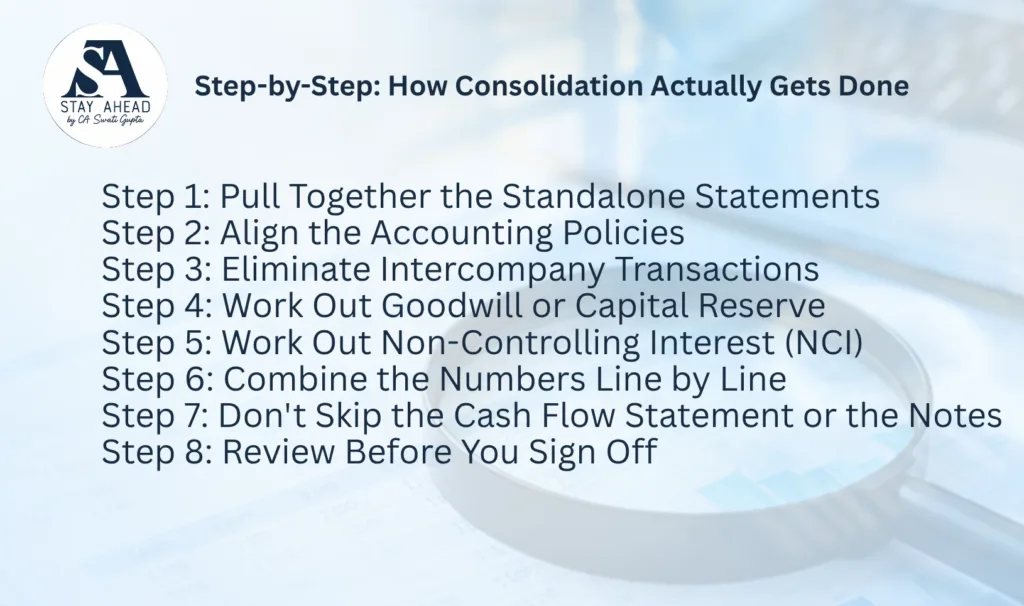
This is where it stops being theory. Below is roughly how the process plays out for a mid-sized group with a handful of subsidiaries.
Step 1: Pull Together the Standalone Statements
Start with the finalised (ideally audited) standalone financial statements of the parent and every subsidiary, all drawn up to the same reporting date. If a subsidiary closes its books on a different date than the parent, you’ll need interim statements to bridge that gap before proceeding.
Step 2: Align the Accounting Policies
Check each entity’s policies against the group standard. Revenue recognition timing, depreciation rates, and provisioning norms are the usual culprits. Flag and restate anything that doesn’t match before moving on.
Step 3: Eliminate Intercompany Transactions
This is where most of the real work — and most of the errors — happen. You’ll need to strip out:
- Intercompany sales and purchases, along with any unrealised profit sitting in closing inventory
- Intercompany loans, receivables, and payables
- Intercompany dividends
- The parent’s investment in the subsidiary, set off against the subsidiary’s corresponding equity
Miss even one of these and group revenue or assets end up overstated — the kind of thing an auditor catches almost immediately.
Step 4: Work Out Goodwill or Capital Reserve
At the point of acquisition, compare what the parent paid against its share of the subsidiary’s net identifiable assets. Pay more than that share, and the difference becomes goodwill. Pay less, and it’s recorded as a capital reserve instead. This gets calculated once, at the time of acquisition — not recomputed every year after.
Step 5: Work Out Non-Controlling Interest (NCI)
Wherever the parent owns less than 100% of a subsidiary, the outside shareholders’ slice — the non-controlling interest — needs its own line within equity. NCI is based on those shareholders’ proportionate share of the subsidiary’s net assets and profit for the year.
Step 6: Combine the Numbers Line by Line
Add the parent’s and subsidiaries’ assets, liabilities, income, and expenses together, line by line, folding in every adjustment from the steps above. That gives you the consolidated balance sheet and the consolidated profit and loss statement.
Step 7: Don’t Skip the Cash Flow Statement or the Notes
The consolidated cash flow statement often gets left until last, but lenders assessing group liquidity care about it as much as anything else. The disclosure notes matter too — they should spell out the basis of consolidation, list every subsidiary included, and explain any judgment calls made, especially in borderline control assessments.
Step 8: Review Before You Sign Off
Reconcile the consolidated figures against the sum of the standalone ones, and check that every elimination entry actually ties out. Having a second person — someone who wasn’t involved in the first draft — review the numbers before audit tends to catch the small errors that are easy to miss when you’ve been staring at the same spreadsheet for two days straight.
Where Finance Teams Usually Slip Up
Even experienced teams run into the same handful of issues, over and over:
- Forgetting to eliminate unrealised profit sitting in inventory that’s been transferred between group companies but not yet sold outside the group
- Not adjusting for subsidiaries with different reporting year-ends
- Treating an associate as a subsidiary, or the other way round, which changes the whole accounting treatment from consolidation to the equity method
- Overlooking foreign subsidiary translation requirements under Ind AS 21 when the group has operations abroad
Catching these before the statutory audit — rather than during it — saves a lot of back-and-forth at year end.
Why Choose CA Swati Gupta
Consolidation isn’t just a technical exercise — it takes someone who understands how group structures actually behave day to day, not just how they look in a textbook example. That’s the gap CA Swati Gupta fills. With hands-on experience consolidating accounts for groups with multiple subsidiaries, joint ventures, and cross-border entities, CA Swati Gupta helps businesses work through the process without the usual confusion.
Clients working with CA Swati Gupta get a team that stays on top of Ind AS updates, understands where intercompany eliminations tend to go wrong, and explains things in language that makes sense to a finance team — not just to an auditor. Whether it’s your first year consolidating or your process has grown a bit messy over time, CA Swati Gupta brings the kind of practical, detail-first support that keeps group reporting accurate and audit-ready.
Conclusion
Consolidated financial statements aren’t just paperwork for the regulator’s sake — they’re the clearest picture available of how a group of companies is actually doing together. Getting there takes a methodical approach: aligning policies across entities, eliminating intercompany transactions carefully, working out goodwill and non-controlling interest correctly, and reviewing everything at least once before it goes out the door.
If you’re managing this process in-house and it’s starting to feel unwieldy, or you’re a business owner trying to make sense of a group structure that’s grown faster than your reporting systems have, working with an experienced partner like CA Swati Gupta can turn what’s usually a stressful exercise into a routine part of the reporting cycle.
Frequently Asked Questions
1. What is the difference between standalone and consolidated financial statements?
Standalone financial statements show a single company’s financial position on its own. Consolidated financial statements combine the parent with its subsidiaries into a single set of accounts, presenting the group as one entity.
2. Is it mandatory for all companies to prepare consolidated financial statements?
Under the Companies Act, 2013, any company with one or more subsidiaries, associates, or joint ventures is generally required to prepare consolidated financial statements — listed or not.
3. What accounting standard governs consolidation in India?
Companies on Ind AS follow Ind AS 110 for consolidation, while those still on the older framework use AS 21. The two differ in a few places, particularly around how “control” is defined.
4. How is non-controlling interest calculated?
It’s the portion of a subsidiary’s equity that doesn’t belong to the parent, worked out based on the non-controlling shareholders’ proportionate share of the subsidiary’s net assets and profits.
5. Why does eliminating intercompany transactions matter so much?
Without it, the consolidated statements would overstate group revenue and assets, giving anyone reading them a misleading sense of how the group is actually performing.