
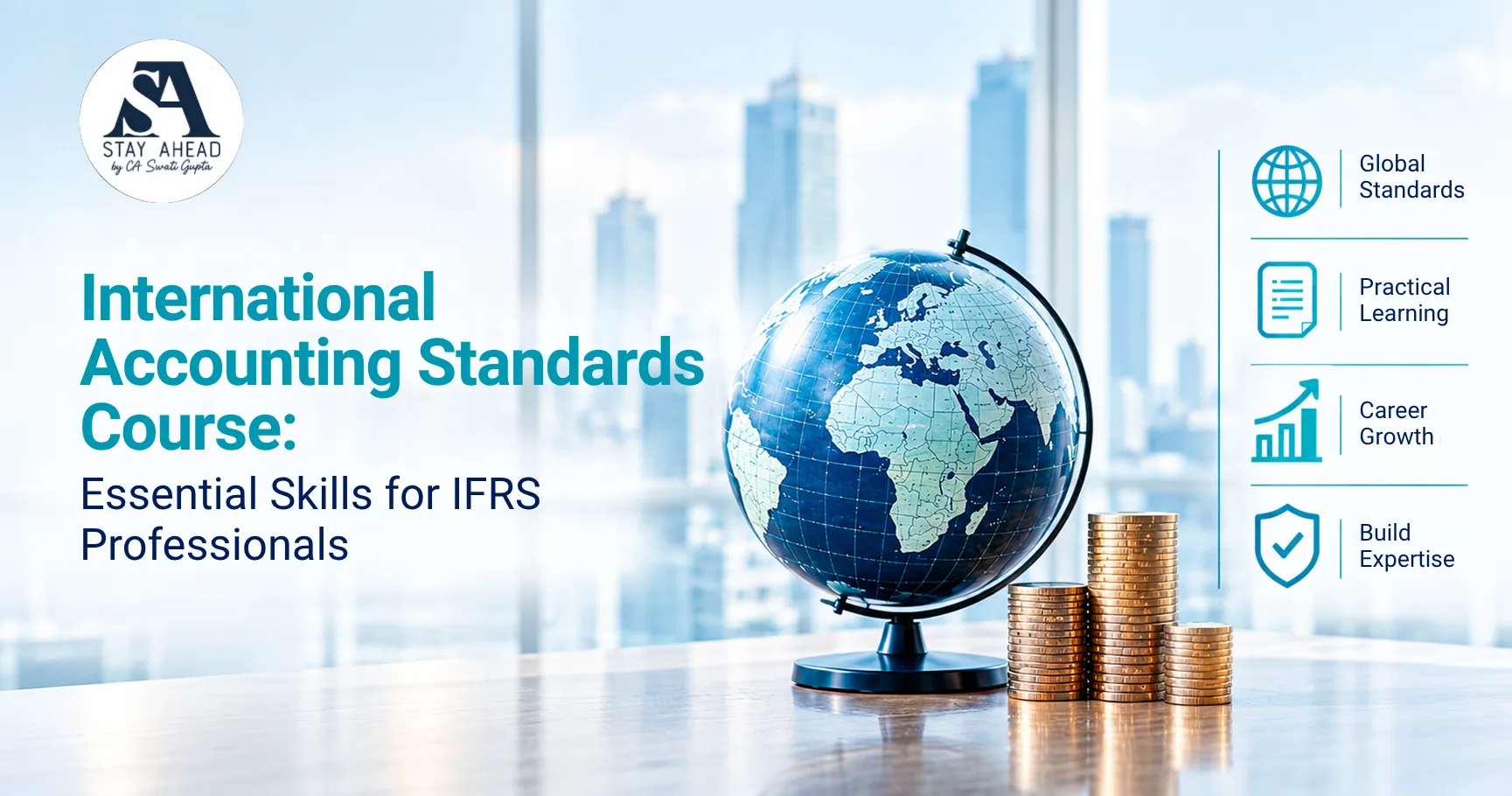
If you’ve ever sat across the table from a client whose parent company is based in London while the subsidiary operates out of Mumbai, you already know why an international accounting standards course isn’t just another line on a resume. It’s the difference between being able to close a set of books and being able to explain, with confidence, why those books look the way they do to an auditor, a regulator, or a CFO who’s flying in from another continent.
I’ve worked with enough finance teams to see the same pattern repeat itself. A talented accountant who’s excellent with Indian GAAP suddenly gets handed a cross-border consolidation project and freezes. Not because they lack ability, but because nobody ever walked them through how IFRS actually thinks about group accounting. That gap is exactly what a well-structured IFRS course is meant to close.
In this post, I want to walk you through what an international accounting standards course should really cover, why the skill of preparing consolidated financial statements sits at the heart of it, and how you can tell a course that will actually make you employable from one that just hands you a PDF of standards to memorise. Along the way, we’ll also touch on areas like IFRS 16 Leases, which trips up more professionals than you’d expect, simply because the old “operating lease vs. finance lease” thinking doesn’t apply anymore.
Why IFRS Knowledge Has Stopped Being Optional
A decade ago, IFRS expertise was something you picked up “if you happened to work on an MNC account.” That’s no longer true. With Ind AS converging closely with IFRS, and Indian companies increasingly listing abroad, raising foreign capital, or being acquired by international groups, understanding global accounting standards has become a baseline expectation, not a specialisation.
Recruiters at Big Four firms and multinational corporates now routinely ask candidates to walk through IFRS 15 Revenue Recognition or explain lease accounting under IFRS 16 in interviews. Not as a bonus question, but as a filter. If you can’t answer, you’re often out of the running before salary even comes up.
This is the practical reason an international accounting standards course matters: it’s less about the certificate and more about being able to hold your own in a room where IFRS is the working language.
What a Good International Accounting Standards Course Should Actually Teach
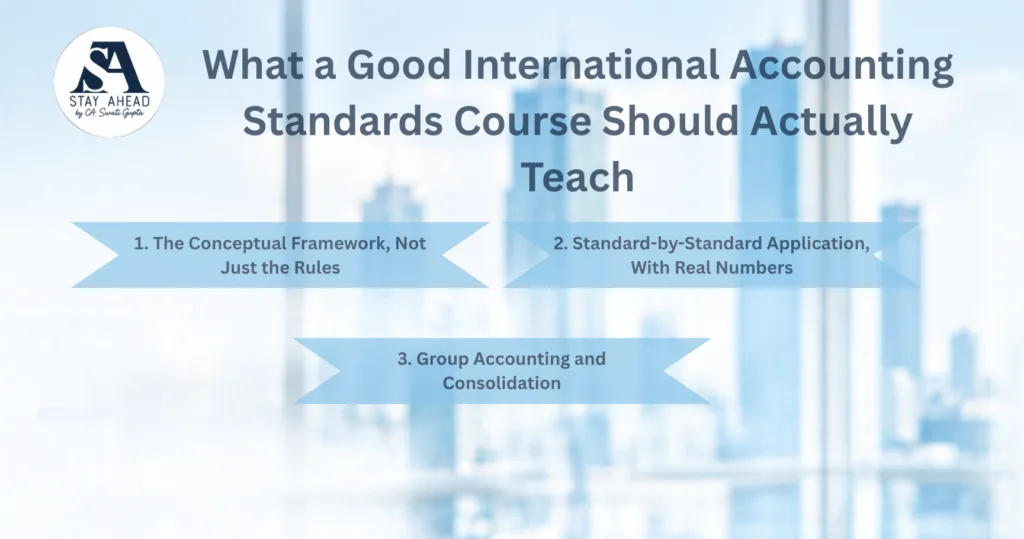
Not every course labelled “IFRS training” is built the same way. Some are little more than a reading of the standards. A genuinely useful course should give you working knowledge in three areas.
1. The Conceptual Framework, Not Just the Rules
Before you touch a single standard, you need to understand the logic IFRS is built on — things like the definitions of assets and liabilities, fair value measurement, and the substance-over-form principle. Skip this, and every standard you learn afterward feels like a disconnected rule rather than part of a coherent system.
2. Standard-by-Standard Application, With Real Numbers
It’s one thing to know that IFRS 9 deals with financial instruments. It’s another to actually classify a bond, calculate expected credit loss, and journal the entry correctly. This is also where Revenue Recognition Accounting deserves real attention — the five-step model under IFRS 15 sounds straightforward on a slide, but applying it to a contract with multiple performance obligations, variable consideration, or milestone billing is a different exercise altogether. A course worth your time will push you through worked examples on the standards that come up most often in practice: IFRS 9, IFRS 15, IFRS 16, and IAS 36 for impairment.
3. Group Accounting and Consolidation
This is where most professionals genuinely struggle, and it deserves its own section, because frankly, it’s the part of IFRS that separates people who can talk about the standards from people who can actually apply them.
How to Prepare Consolidated Financial Statements: The Part Everyone Underestimates
Ask any experienced controller which topic trips up new hires the most, and consolidation usually tops the list. It isn’t that the concept is exotic. Combining a parent’s and subsidiaries’ financials into one set of statements is a familiar idea. It’s the mechanics that catch people off guard.
Here’s roughly how the process should unfold once you know what you’re doing:
Establish control first. Before any numbers are touched, you need to determine whether the parent actually controls the subsidiary under IFRS 10. Voting rights alone don’t always settle it, and structured entities or de facto control situations are where this gets genuinely tricky.
Align accounting policies and reporting dates. You can’t consolidate two entities using different depreciation methods or different year-ends without adjustment first. This step is often skipped by juniors, and it quietly distorts the entire consolidated set.
Eliminate intercompany transactions. Sales between group companies, intercompany loans, and unrealised profits sitting in closing inventory all need to be stripped out. Miss one intercompany balance and your consolidated balance sheet simply won’t tie.
Calculate and present non-controlling interests. When a parent owns less than 100% of a subsidiary, you need to correctly split equity and profit between the group and the minority shareholders — mathematically simple, but conceptually confusing for many first-timers.
Handle goodwill and fair value adjustments on acquisition. Any difference between what was paid for the subsidiary and the fair value of its identifiable net assets typically becomes goodwill, and it needs to be tested for impairment going forward, not amortised casually.
Prepare the consolidated statements themselves — the balance sheet, income statement, statement of changes in equity, and cash flow statement — making sure every elimination and adjustment flows through consistently across all four.
None of this is difficult in isolation. What makes it hard is doing it accurately under time pressure, across multiple subsidiaries, sometimes in different currencies. If you want a deeper walkthrough of the full process, we’ve broken it down step by step on our Consolidation of Financial Statements page. That’s precisely the kind of scenario a good international accounting standards course should simulate, rather than just describe on a slide.
Who Actually Needs This Skill Set
You don’t need to be aiming for a Big Four partnership to benefit from this. In practice, I’ve seen the need come up for:
- CA and CMA finalists who want an edge in campus placements with MNCs
- Working professionals in finance and audit roles suddenly handed a group reporting mandate
- Founders and CFOs of growing companies preparing for foreign investment or a cross-border listing
- Finance teams supporting a parent company based overseas that reports under IFRS
If your career touches any of these situations, even occasionally, the time spent learning consolidation properly pays for itself the first time you’re not the person holding up month-end close because the eliminations don’t balance.
What to Look for Before Enrolling in Any IFRS Course
A few honest questions worth asking before you sign up for a program:
- Does it include practical case studies on consolidation, or only theory?
- Will you actually build a consolidated worksheet yourself, or just watch one being built?
- Is the trainer someone with real audit or industry experience with IFRS, or purely an academic?
- Does the course stay updated as standards like IFRS 16 and IFRS 17 evolve?
If the answer to most of these is yes, you’re likely looking at a course that will hold up once you’re back at your desk.
Why Choose CA Swati Gupta
There’s no shortage of IFRS courses online, but most of them are built to be consumed passively. Watch a video, read a summary, move on. What actually changes how you work is training built by someone who has sat on the other side of the table, closing books, defending positions to auditors, and untangling real consolidation problems, not textbook ones.
That’s the approach behind the training and guidance offered through caswatigupta. Rather than treating IFRS as a set of rules to memorise, the focus stays on how these standards play out in real financial statements — including the exact kind of consolidation challenges covered above. Whether you’re a CA finalist trying to stand out, a finance professional stepping into a group reporting role for the first time, or a business owner trying to make sense of your own consolidated numbers, the goal at caswatigupta is to make sure you leave with skills you can use on day one, not just a certificate to file away.
If building genuine confidence in IFRS and consolidated reporting is what you’re after, that practical, experience-led approach is what sets caswatigupta apart from a purely theoretical course.
Frequently Asked Questions
1. What is the difference between IFRS and an international accounting standards course?
IFRS refers to the actual set of global accounting standards issued by the IASB. An international accounting standards course is structured training built around those standards, meant to teach you how to interpret and apply them in real financial reporting situations.
2. Is Ind AS the same as IFRS?
Not exactly, but they’re closely aligned. Ind AS is India’s version of IFRS, adapted with certain carve-outs and modifications to suit local regulatory requirements. Most of the underlying principles, including those for consolidation, remain very similar.
3. How long does it typically take to learn how to prepare consolidated financial statements properly?
It depends on your starting point, but most professionals with a solid accounting foundation can grasp the core mechanics within a few focused weeks of structured training, especially when the course includes hands-on practice rather than just theory.
4. Do I need IFRS knowledge if I only work with Indian companies?
Increasingly, yes. Many Indian companies now have foreign subsidiaries, foreign parent companies, or plans to raise international capital, all of which require IFRS or IFRS-aligned reporting at some point.
5. Can working professionals with full-time jobs manage an IFRS course alongside work?
Yes, most well-designed courses are structured with working professionals in mind, using recorded sessions, weekend batches, or flexible timelines so you can build this skill without stepping away from your current role.